The Mental Health Professional's Guide to Telehealth Coding
Why Getting Telehealth Codes for Behavioral Health Right Determines Your Revenue
Telehealth codes for behavioral health are a moving target — and using the wrong one costs you real money.
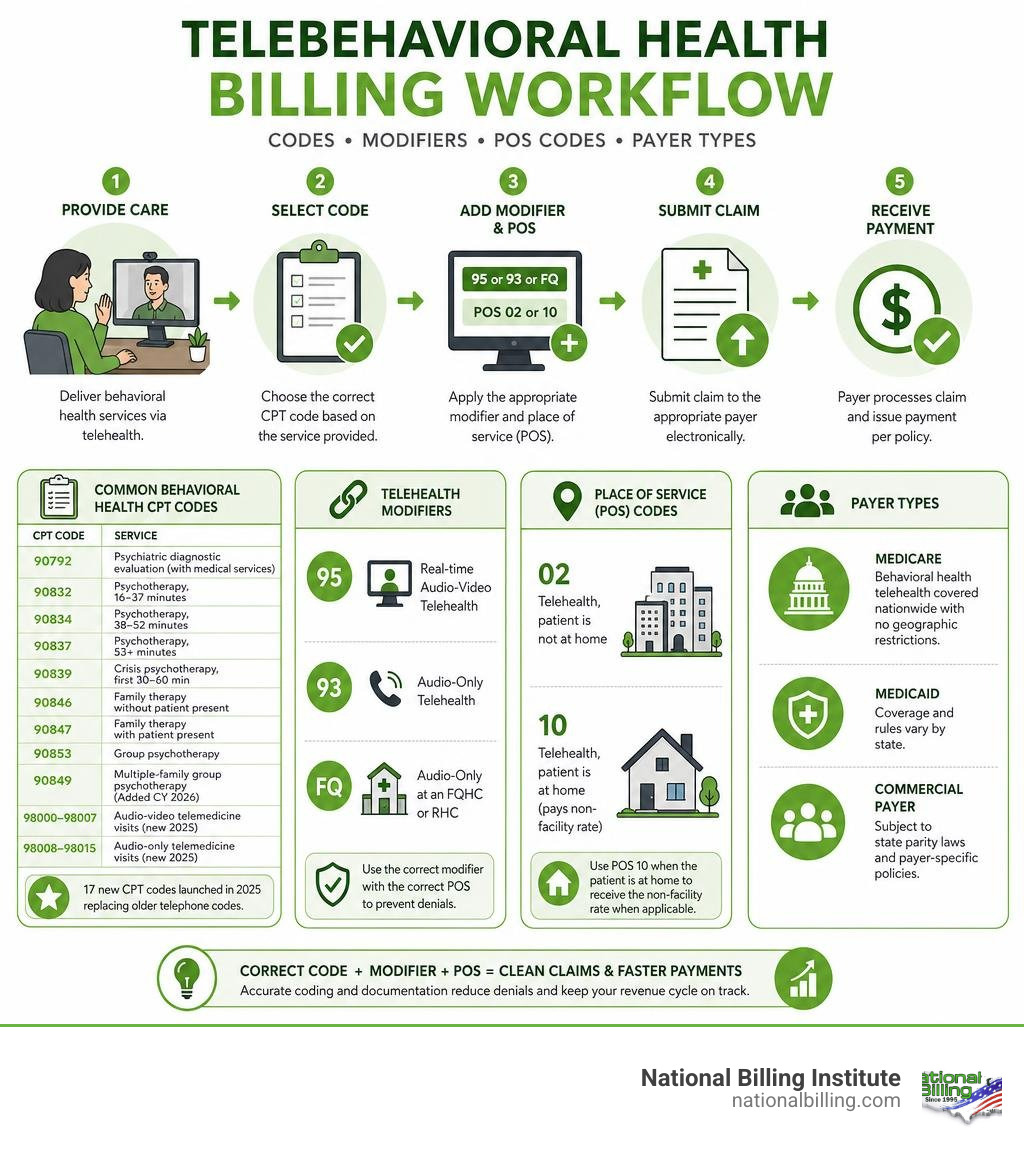
Here are the most commonly used codes to know right now:
CPT/HCPCS Code Service Description Medicare Permanent Coverage 90791 Psychiatric diagnostic evaluation (no medical services) Yes 90792 Psychiatric diagnostic evaluation (with medical services) Yes 90832 Psychotherapy, 16–37 minutes Yes 90834 Psychotherapy, 38–52 minutes Yes 90837 Psychotherapy, 53+ minutes Yes 90839 Crisis psychotherapy, first 30–60 min Yes 90846 Family therapy without patient present Yes 90847 Family therapy with patient present Yes 90853 Group psychotherapy Yes 90849 Multiple-family group psychotherapy Yes (added CY 2026) 98000–98007 Audio-video telemedicine visits (new 2025) Verify by payer 98008–98015 Audio-only telemedicine visits (new 2025) Verify by payer
Key modifiers and place of service codes you also need to get right:
Modifier 95 — real-time audio-video telehealth
Modifier 93 — audio-only telehealth
Modifier FQ — audio-only at an FQHC or RHC
POS 02 — telehealth, patient is not at home
POS 10 — telehealth, patient is at home (pays non-facility rate)
Getting these combinations wrong is one of the most common reasons behavioral health claims get denied before a reviewer ever reads a note.
The rules have grown more complex every year since the pandemic. Medicare has permanently removed geographic restrictions for behavioral health telehealth. Seventeen new CPT codes launched in 2025 to replace older telephone codes. New 2026 G-codes replaced the entire Collaborative Care Model code family. And 44 states plus the District of Columbia now have private-payer reimbursement parity laws on the books — each with its own fine print.
For a busy practice, keeping up feels impossible. But the cost of not keeping up is measurable: denied claims, delayed payments, and compliance exposure.
I'm Olivia Harper, founder of National Billing Institute and a denial management specialist with over 30 years of hands-on experience in revenue cycle management, including deep expertise in telehealth codes for behavioral health across Medicare, Medicaid, and commercial payers. In this guide, I'll walk you through every layer of telebehavioral health billing — codes, modifiers, payer rules, documentation, and the 2025–2026 changes you can't afford to miss.
Core Telehealth Codes for Behavioral Health and Psychotherapy
When billing for virtual mental health services, the foundational CPT codes remain largely identical to those used for in-person care. However, the way you report them to Medicare, Medicaid, and commercial insurers hinges on modifiers, place of service (POS) designations, and precise time documentation.
Medicare permanently covers 17 core behavioral health telehealth CPT codes. This permanent status means you can build your practice workflows around these codes without worrying about sudden coverage expirations. To understand how these codes are defined, it is highly recommended to consult the official guidance on Billing for telebehavioral health | Telehealth.HHS.gov .
Psychiatric Diagnostic Evaluations and Individual Therapy
The starting point of any behavioral health treatment plan is the diagnostic evaluation:
CPT 90791 (Psychiatric Diagnostic Evaluation without Medical Services): This code is billed by licensed clinical social workers (LCSWs), licensed professional counselors (LPCs), licensed marriage and family therapists (LMFTs), and clinical psychologists. It represents a comprehensive diagnostic assessment of history, mental status, and recommendations.
CPT 90792 (Psychiatric Diagnostic Evaluation with Medical Services): This is reserved for medical professionals, such as psychiatrists and psychiatric-mental health nurse practitioners (PMHNPs), who perform medical evaluations alongside the psychiatric assessment, including medication reviews and physical evaluations.
For ongoing treatment, individual psychotherapy codes are selected strictly based on the actual face-to-face time spent with the patient:
CPT 90832 (Psychotherapy, 30 minutes): Applies to sessions lasting 16 to 37 minutes.
CPT 90834 (Psychotherapy, 45 minutes): Applies to sessions lasting 38 to 52 minutes.
CPT 90837 (Psychotherapy, 60 minutes): Applies to sessions lasting 53 minutes or more.
Time thresholds are absolute. If you conduct a 50-minute session, you must bill CPT 90834. Billing 90837 for any session under 53 minutes constitutes upcoding and is one of the most heavily audited billing patterns in outpatient mental health.
Family and Group Psychotherapy via Telehealth
Group and family dynamics translate exceptionally well to virtual care, and the AMA has updated its coding pathways to support this:
CPT 90846 (Family Psychotherapy, patient not present): Used when meeting with family members to discuss the patient's treatment plan without the patient online.
CPT 90847 (Family Psychotherapy, patient present): Used for joint family therapy sessions where the patient is actively participating in the video call.
CPT 90853 (Group Psychotherapy): Billed per patient for group therapy sessions conducted via a secure video platform.
CPT 90849 (Multiple-Family Group Psychotherapy): This code has been added to the Medicare permanent telehealth services list for CY 2026, allowing multiple families to participate in structured group therapy remotely.
Navigating Telehealth Modifiers and Place of Service (POS) Codes
A perfect CPT code will still get rejected if your Place of Service (POS) and modifiers do not align. Think of these as the coordinates that tell the payer exactly where you were, where the patient was, and how you communicated.
Incorrect modifier use is a primary driver of outpatient denials. To keep your cash flow steady, review our deep-dive guide on Telehealth Modifiers 2026.
Place of Service Codes: POS 02 vs. POS 10
The introduction of POS 10 revolutionized behavioral health reimbursement. Here is how to choose between the two:
POS 10 (Telehealth Provided in Patient’s Home): Use this code when the patient is located in their private residence (or a non-public, private location like their car for confidentiality) during the session. Under Medicare rules, billing POS 10 triggers reimbursement at the non-facility rate, which is typically higher than the facility rate because it accounts for the provider's office overhead.
POS 02 (Telehealth Provided Other than in Patient’s Home): Use this code if the patient is located in an office, hospital, clinic, or any location other than their home. This pays at the facility rate, which is lower.
Telehealth Modifiers for Audio-Video and Audio-Only Sessions
Modifiers tell the insurance payer the exact modality of your session. For detailed modifier rules, check out our resource on Telehealth Billing Modifiers and cross-reference it with our complete list of Telehealth Billing Codes.
Modifier 95 (Synchronous Audio-Video): Append this modifier to your CPT codes when you deliver services via real-time, interactive, HIPAA-compliant video technology.
Modifier 93 (Synchronous Audio-Only): Append this modifier when a session is conducted entirely over the telephone. This is only covered by Medicare and certain commercial payers under strict clinical and documentation guidelines.
Modifier FQ (Audio-Only for FQHCs/RHCs): Federally Qualified Health Centers and Rural Health Clinics must use this specific modifier when billing for audio-only mental health visits.
New and Revised Telemedicine Codes for 2025 and 2026
The American Medical Association (AMA) and CMS have actively restructured virtual care coding to eliminate outdated telephone codes and introduce dedicated digital health pathways. You can stay ahead of these changes by reviewing the official CMS Telehealth Billing Codes.
The 98000-98016 Code Series for Telehealth Codes for Behavioral Health
In 2025, the AMA introduced a massive update: 17 new CPT codes (98000–98016) specifically designed for digital and telemedicine visits, effectively replacing older phone consultation codes. To understand how these apply to your practice, consult the guide on Telehealth CPT Codes 2025: Understanding for 2025 and Beyond .
CPT 98000–98007 (Audio-Video Telemedicine Visits): These codes represent synchronous online evaluations based on medical decision-making (MDM) or precise time thresholds, creating a dedicated pathway for virtual-first practices.
CPT 98008–98015 (Audio-Only Telemedicine Visits): These codes officially replace the old telephone codes (99441–99443), providing structured levels of reimbursement based on the complexity and duration of the phone call.
CPT 98016 (Virtual Check-In): This virtual check-in code replaces HCPCS G2012, allowing brief digital assessments to determine if a full in-person or telehealth visit is necessary.
New 2026 Medicare Behavioral Health Codes
Starting in CY 2026, several key additions and changes have taken effect:
CPT 90849 (Multiple-Family Group Psychotherapy): Now permanently covered on the Medicare telehealth list.
HCPCS G0560 (Safety Planning Intervention): A specialized billing code for patients presenting with elevated suicide or self-harm risk, requiring a dedicated safety planning protocol.
HCPCS G0544 (Follow-Up Contacts Post-Crisis): Designed to reimburse clinicians for structured follow-up calls or video check-ins with Medicare patients who have recently experienced a psychiatric crisis.
Collaborative Care Model Replacements: The CPT codes 99492, 99493, and 99494 have been deleted and replaced with new G-codes (G0568, G0569, and G0570). Any claims submitted with the deleted codes will face automatic denials.
Same-Day E/M and Psychotherapy Billing Rules
For psychiatrists and psychiatric nurse practitioners, billing an Evaluation and Management (E/M) service and a psychotherapy service on the same day is a highly effective way to provide integrated care. However, it requires strict adherence to NCCI (National Correct Coding Initiative) edits and the proper use of modifier 25. Learn the mechanics of this in our guide on How to Bill for Telemedicine Visits and How to Bill Telemedicine Visits 2025.
Selecting E/M Codes by Medical Decision Making (MDM)
When you perform both services on the same day, you cannot use time to select your E/M code level.
Because the psychotherapy portion of the visit is a timed add-on code, using time to select the E/M code would result in "double-counting" the minutes spent with the patient. Therefore, the E/M code level must be selected based on Medical Decision Making (MDM) complexity only.
To bill this successfully:
Select the appropriate outpatient E/M code (e.g., 99213 or 99214) based on MDM.
Append Modifier 25 to the E/M code to show it was a significant, separately identifiable service.
Add the appropriate psychotherapy add-on code based on the exact time spent only on therapy:
CPT 90833: 30-minute psychotherapy add-on (16–37 minutes).
CPT 90836: 45-minute psychotherapy add-on (38–52 minutes).
CPT 90838: 60-minute psychotherapy add-on (53+ minutes).
Payer-Specific Rules: Medicare, Medicaid, and Private Insurers
While Medicare sets the baseline for national billing standards, Medicaid and private commercial insurers frequently diverge. Understanding these differences prevents unexpected write-offs. Get an overview of state-level variations in our resource on Medicaid Telehealth Billing and learn about nationwide guidelines at USA Telemedicine Billing.
Medicare Telehealth Flexibilities and In-Person Requirements
The Consolidated Appropriations Act permanently removed geographic and originating-site restrictions for Medicare behavioral health telehealth services. This means patients can receive virtual care from anywhere in the country, including their own homes.
Furthermore, Medicare telehealth flexibilities for mental health have been extended, and the highly debated "in-person visit requirement" (which would require an in-person visit within 6 months of starting telehealth and annually thereafter) has been delayed. For established patients who began their care via telehealth, this delay provides significant relief, though practices must remain prepared for eventual compliance deadlines.
Medicaid and Private Payer Telehealth Codes for Behavioral Health Policies
Medicaid policies are highly fragmented. Some states offer total parity for both audio-video and audio-only sessions, while others restrict audio-only entirely. To navigate these state-by-state discrepancies, review the TeleBehavioral Health 501 Training Series and check out the billing recaps on Behavioral health and telemedicine - CodingIntel .
In the commercial space, 44 states and the District of Columbia have enacted private-payer telehealth reimbursement parity laws. However, "payment parity" does not always mean equal reimbursement rates; some states only require coverage parity (meaning they must cover the service, but can pay a lower rate than in-person). Always verify commercial payer contracts to ensure they reimburse telebehavioral health at 100% of your in-person rates.
FQHC and RHC Telebehavioral Health Billing
Federally Qualified Health Centers (FQHCs) and Rural Health Clinics (RHCs) operate under entirely different billing structures:
They bill telehealth services using HCPCS code G2025.
For audio-only sessions, they must append modifier FQ to demonstrate that the patient did not have access to, or declined, video technology.
The originating-site facility fee (HCPCS Q3014) is $31.04 for CY 2025 and increases to $31.85 for CY 2026 (reflecting a 2.7% Medicare Economic Index increase).
Documentation Standards to Prevent Telehealth Claim Denials
The ultimate defense against audits and recoupments is a compliant progress note. If a claim is audited, the clinical note must explicitly justify why the service was delivered virtually and prove that a secure, compliant connection occurred.
To protect your practice from audits, implement the steps detailed in our guide on How to Bill Telemedicine Visits 2025.
Essential Elements of a Compliant Telebehavioral Health Note
Every telebehavioral health progress note should explicitly state:
Start and Stop Times: Exact session duration (e.g., "Session started at 10:02 AM and ended at 10:51 AM").
Modality Used: Explicitly state if the session was interactive audio-video or audio-only (e.g., "Services delivered via secure, HIPAA-compliant Zoom video platform").
Patient Location: Confirm the patient's physical location (e.g., "Patient was located at their home in Boca Raton, FL"). This is legally required to verify state licensure compliance.
Provider Location: Confirm where you were (e.g., "Provider located at clinical office").
Informed Consent: Document that the patient consented to receive services via telehealth.
Clinical Justification (For Audio-Only): If you are billing an audio-only session (Modifier 93), you must document that the patient declined video, lacked the technology, or that video was clinically contraindicated, and that you were technically capable of video delivery. Learn more about protecting your claims through the Telehealth Billing for Behavioral Health: Complete Guide to Virtual ... resource.
Frequently Asked Questions about Telebehavioral Health Billing
Can I bill CPT 90837 for a 50-minute telehealth session?
No. Under AMA and CMS guidelines, CPT 90837 requires a minimum of 53 minutes of continuous, face-to-face psychotherapy. If your session lasted 50 minutes, you must bill CPT 90834 (which covers 38 to 52 minutes). Routinely billing 90837 for sessions that do not meet the 53-minute threshold is considered upcoding and is a primary target for insurance audits.
When is audio-only billing allowed for mental health services?
Medicare and some Medicaid/commercial plans cover audio-only behavioral health (using modifier 93 or FQ) under specific conditions:
The patient must be located at home.
The patient does not have the technology required for video, lacks sufficient broadband, or explicitly declines video.
The practitioner must have the technical capability to provide audio-video services but defaulted to audio-only due to patient preference or technical failure.
The choice of audio-only must be clearly documented in the clinical note.
Do I need separate credentialing to bill for telehealth services?
Generally, no. If you are already credentialed and in-network with a payer for in-person services, you do not need a completely separate credentialing process for telehealth. However, you must verify that your contract specifically includes telehealth billing privileges and that the payer does not route their virtual mental health services through a third-party "behavioral health carve-out" network.
Conclusion
Mastering telehealth codes for behavioral health is no longer just about memorizing a few CPT codes; it requires a deep, ongoing understanding of modifiers, place of service rules, and rapidly shifting federal and state guidelines. One minor oversight on a modifier can lead to a wave of denials that disrupts your practice's cash flow.
At National Billing Institute, we take the administrative burden off your shoulders. Our 100% USA-based team in Boca Raton, FL, brings over 30 years of specialized experience in behavioral health billing. By combining cutting-edge, AI-automated claims processing with dedicated human expertise, we maintain the industry's lowest denial rates and consistently increase our clients' revenue by 15% to 30%.
Let us handle the complexities of telebehavioral health billing while you focus on what matters most: caring for your patients.
Explore National Billing Institute Services today to secure your revenue cycle.
