The 2026 Telehealth Billing Update Guide
Why telehealth codes 2026 Are Changing How Providers Get Paid
If you need a quick answer on which telehealth codes apply in 2026, here is the short version:
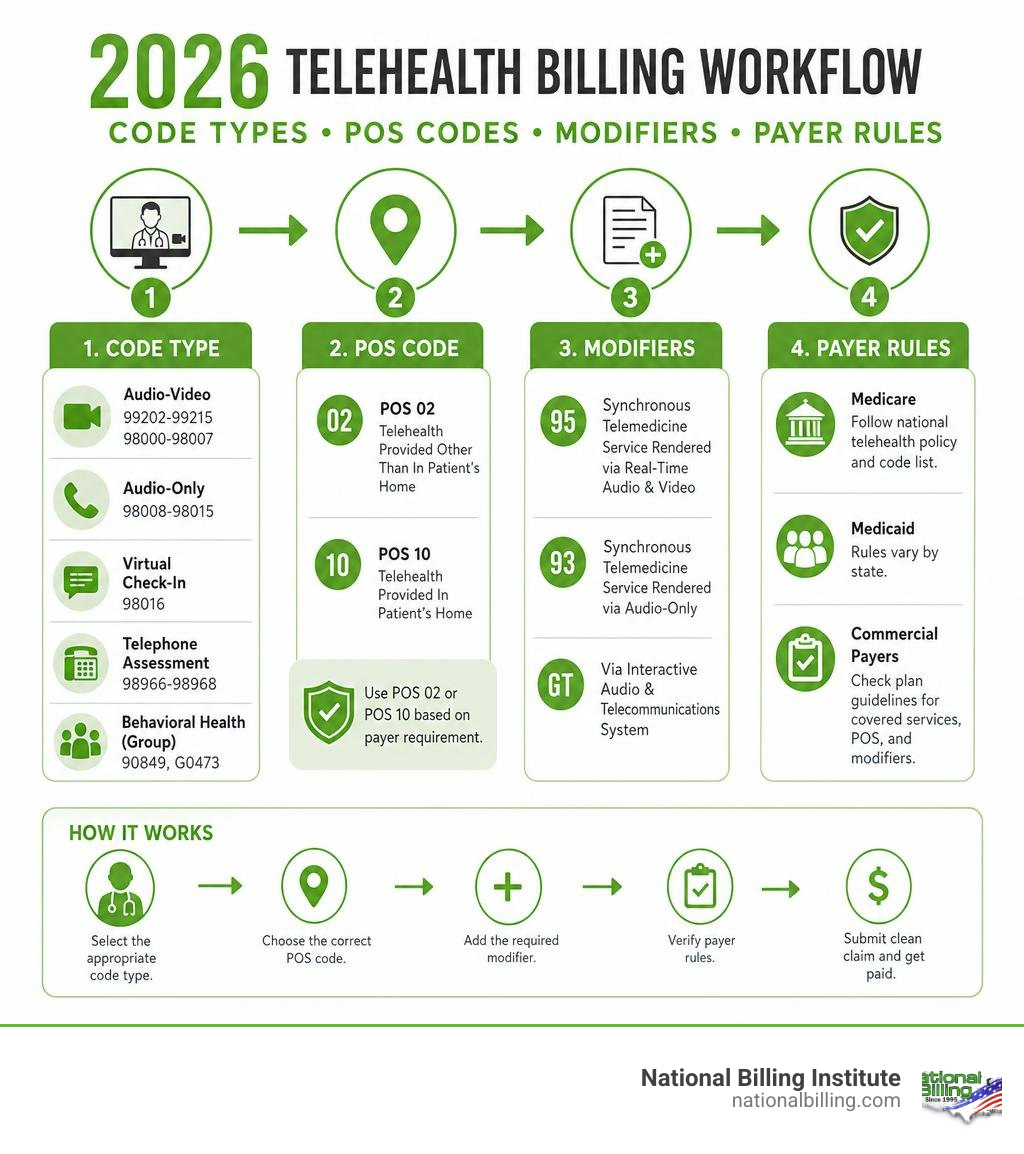
Service Type Primary Codes Key Requirement Audio-video (most payers) 99202-99215 POS 02 or POS 10 + modifier 95 Audio-video (commercial) 98000-98007 Payer-specific acceptance required Audio-only 98008-98015 Modifier 93; payer must accept Brief virtual check-in 98016 Replaces deleted G2012 Telephone assessment 98966-98968 Non-E/M; limited coverage Behavioral health (group) 90849, G0473 New to Medicare list in 2026
Note: Codes 99441-99443 were permanently deleted January 1, 2025. Do not bill them.
The landscape for telehealth codes in 2026 looks very different from even two years ago. The Consolidated Appropriations Act of 2026 extended core Medicare telehealth flexibilities through December 31, 2027. At the same time, the AMA added nearly 300 new CPT codes for digital health services, behavioral health telehealth became permanently covered under Medicare, and CMS added five new codes to its official telehealth services list.
That is a lot of moving parts — and getting even one piece wrong can trigger a denial or an audit.
For practices already stretched thin by administrative work and claim denials, these updates create real risk. The rules are different depending on whether you bill Medicare, Medicaid, or a commercial payer. The codes you use, the modifiers you append, and the place-of-service code you select all affect whether you get paid — and how much.
This guide breaks it all down clearly so your billing team can act on it today.
I'm Olivia Harper, Founder and Denial Management Specialist at National Billing Institute, and over my 30 years in revenue cycle management I've helped hundreds of practices navigate exactly these kinds of shifts in telehealth codes for 2026 and prior years — from the pandemic-era waivers all the way through today's permanent policy changes. The sections ahead reflect what our team is seeing on the ground right now, so you can avoid the denials we are already catching for our clients.
Key Telehealth Codes 2026: Audio-Video, Audio-Only, and Virtual Check-Ins

Navigating the transition of CPT codes can feel like trying to hit a moving target while riding a unicycle. In 2026, the target has split into two distinct tracks: the traditional Evaluation and Management (E/M) codes that Medicare continues to favor, and the newer 98000 series designed specifically for digital health.
Synchronous communication—which simply means real-time, face-to-face interaction—remains the gold standard for virtual care. For most insurance claims, you will still rely on the standard outpatient E/M codes (99202-99215). However, the AMA's introduction of the 98000 series has created a specialized taxonomy for digital health. This series is divided into distinct bands: 98000-98007 for synchronous audio-video encounters, 98008-98015 for synchronous audio-only encounters, and 98016 for brief virtual check-ins.
Understanding how to navigate these options is critical for clean claims. To build a solid foundation, you can review our comprehensive breakdown of telehealth billing codes.
One of the most significant structural changes in recent years was the permanent deletion of the old telephone E/M codes (99441-99443). If your billing software still has those codes auto-saved in a template, delete them immediately. Submitting a deleted code is a fast-track ticket to an instant denial. Instead, commercial payers who have adopted the new AMA framework expect you to bill using the 98008-98015 series for audio-only care, while Medicare requires traditional E/M codes with specific modifiers.
Synchronous Audio-Video Telehealth Codes 2026
For standard audio-video visits where you can see and hear the patient in real-time, the coding path depends entirely on the payer.
Medicare has historically declined to adopt the newer 98000-98007 series. For Medicare Fee-for-Service (FFS) claims, you must continue to use the traditional office visit codes (99202-99215). These codes represent the same level of medical decision-making (MDM) or total time spent as an in-person visit.
Conversely, commercial plans and select Medicaid programs have increasingly adopted the 98000-98007 series. These codes are structured specifically for telemedicine E/M, eliminating the need to append certain modifiers because the code descriptor itself specifies that the service was delivered via telehealth.
Because payer rules are so split, your billing team must verify which code set each contract recognizes. You can cross-reference your codes with the official List of Telehealth Services | CMS to ensure your Medicare claims align with federal guidelines.
Synchronous Audio-Only Telehealth Codes 2026
Audio-only care—essentially a structured, medically necessary telephone consultation—is a vital lifeline for patients in rural areas or those without reliable internet access. However, because you cannot see the patient, payers apply much higher scrutiny to these claims.
Under the 2026 guidelines, commercial payers who recognize the AMA's digital codes utilize the 98008-98015 series. These codes require a minimum of 10 minutes of medical discussion to be billable. For non-physician qualified healthcare professionals (such as physical therapists or speech-language pathologists), the telephone assessment codes 98966-98968 remain active and billable under specific payer guidelines.
Reimbursement parity for audio-only services is shrinking. In the commercial market, approximately 40% of plans have reduced audio-only reimbursement to 70% to 85% of the standard audio-video rate, or stopped covering audio-only mental health visits entirely. To protect your revenue, your documentation must explicitly state why an audio-only format was used (e.g., "patient lacks video-capable technology; audio-video was attempted but failed due to bandwidth constraints").
Payer Alignment: Medicare, Medicaid, and Commercial Variations
The biggest headache in modern medical billing is that no two payers play by the same rules. What is fully covered by Medicare might be flatly denied by a regional commercial plan.
The table below outlines how the three major payer categories handle telehealth codes 2026:
Feature Medicare FFS Medicaid (State-Specific) Commercial Payers E/M Code Choice 99202-99215 Varies (Most use 99202-99215) 99202-99215 or 98000-98015 Audio-Only Coverage Allowed through Dec 2027 Varies widely by state Highly restricted; lower rates POS Codes Required POS 10 (Home) or POS 02 (Other) POS 02 or 10 POS 02 or 10 (Payer choice) Key Modifier None for FFS (uses POS); FQ/93 for audio-only Modifier 95 or GT Modifier 95 (video) or 93 (audio) Originating Site Fee $31.85 (Q3014) Varies Rarely paid
To avoid billing errors that lead to delayed payments, it is essential to understand the specific rules governing federal programs. You can read more about these requirements in our guide on cms telehealth billing codes.
Medicare Telehealth Rules and Extensions
Medicare’s approach to telehealth in 2026 is defined by stability with a side of caution. Thanks to the Consolidated Appropriations Act of 2026, the core telehealth flexibilities we grew accustomed to have been extended through December 31, 2027. This means:
Geographic restrictions remain waived (patients can receive care from any location, including their home).
Rural Health Clinics (RHCs) and Federally Qualified Health Centers (FQHCs) will continue to receive special payment rates for medical telehealth services through December 31, 2026, and permanently for behavioral health.
Medicare pays for telehealth services delivered to a patient in their home (POS 10) at the non-facility rate, which is significantly higher than the facility rate.
Additionally, the Medicare originating site facility fee (billed under HCPCS code Q3014 when a patient physically goes to an originating site to connect with a distant specialist) has increased to $31.85 for CY 2026, reflecting a 2.7% Medicare Economic Index (MEI) increase. To keep up with these shifting federal regulations, bookmark the official Telehealth policy updates page.
Medicaid and Commercial Payer Policies
While Medicare provides a reliable baseline, the commercial and Medicaid markets are highly fragmented.
Currently, over 35 states have enacted some form of telehealth payment parity laws, mandating that insurers reimburse virtual visits at the same rate as in-person care. However, the fine print in these laws varies. Some states only mandate parity for audio-video visits, leaving audio-only services subject to severe reimbursement cuts.
Prior authorization has also returned with a vengeance. Many commercial insurers now require pre-authorization for ongoing telehealth services, particularly in physical therapy, occupational therapy, and speech therapy. Furthermore, state-by-state Medicaid rules dictate whether a patient must have an established relationship with a provider before receiving virtual care. To navigate this complex web, check out our deep dive into medicaid telehealth billing.
Place of Service (POS) Codes and Modifiers for 2026

If codes are the "what" of medical billing, POS codes and modifiers are the "where" and "how." Using the wrong combination is one of the top three reasons telehealth claims are denied.
In 2026, the industry has fully embraced the split between POS 02 and POS 10. Simultaneously, modifiers like 95, 93, and FQ are used to clarify the exact technology used during the encounter. If you need a quick refresher on the general mechanics of modifiers, read our article on telehealth billing modifiers.
Selecting POS 02 vs. POS 10
The rule for choosing between POS 02 and POS 10 is simple: it is entirely dependent on the physical location of the patient at the moment the virtual visit occurs.
POS 10 (Telehealth Provided in Patient’s Home): Use this code when the patient is located in their private residence, a temporary lodging (like a hotel), or any residential setting. Billed under POS 10, Medicare and many commercial payers reimburse the claim at the non-facility rate, which covers the provider's clinical overhead.
POS 02 (Telehealth Provided Other than in Patient’s Home): Use this code when the patient is located in a hospital, clinic, nursing facility, or any location that is not their home. This pays at the lower facility rate.
For a detailed look at how these codes have evolved, read our guide on telehealth modifiers 2026.
Applying Telehealth Modifiers Correctly
While Medicare relies heavily on POS codes to identify telehealth, commercial payers and Medicare Advantage plans still require specific modifiers appended to the CPT codes to process claims correctly.
Modifier 95 (Synchronous Audio-Video): Append this to traditional E/M codes (99202-99215) when the visit was conducted using interactive, real-time video technology. Note: You do not append modifier 95 to the new 98000 series, as those codes inherently describe telehealth.
Modifier 93 (Synchronous Audio-Only): Append this to indicate that the service was delivered via real-time, interactive telephone communication.
Modifier FQ (Mental Health Audio-Only): Used specifically for Medicare claims to indicate that a synchronous, audio-only behavioral health service was provided because the patient was unable or unwilling to use video.
Using these correctly prevents unnecessary claim rejections. For more tips on modifier application, refer to our resource on the telehealth modifier.
Expanded Digital Health: Remote Monitoring, AI, and Behavioral Health
The 2026 CPT code set added nearly 300 new codes reflecting the explosive growth of remote monitoring, wearables, and artificial intelligence in medicine. These codes allow providers to get paid for the continuous, data-driven care that happens between traditional office visits.
Remote Physiologic Monitoring (RPM) and Remote Therapeutic Monitoring (RTM) have seen significant updates. Historically, billing for device supply (such as codes 99454 or 98979) required a strict 30-day monitoring period with at least 16 days of data transmission. In 2026, CMS and commercial payers have recognized shorter monitoring intervals—specifically supporting 2-to-15 day monitoring periods for acute conditions, billed under newly refined codes.
Additionally, interactive communication codes (99457 and 99458) still require at least 20 minutes of clinical staff time per calendar month, but documentation must now include time-stamped logs of every interaction.
Behavioral health has also received a permanent boost. New codes added to the Medicare Telehealth Services List for CY 2026 include:
CPT 90849: Multiple family group psychotherapy, now fully billable via telehealth.
HCPCS G0473: Group behavioral counseling for obesity.
HCPCS G0545: A specialized infectious disease add-on code.
To explore how these new digital health and behavioral health codes impact clinical workflows and billing, read the external analysis on Telehealth CPT Codes 2026: Key Updates and Impacts - Creyos .
Documentation Best Practices and Compliance Risks
With the rise of the Department of Government Efficiency (DOGE) and increased federal oversight, Medicare audits targeting telehealth-heavy practices have surged. If your clinical notes look like a copy-and-paste job from 2020, you are sitting on a compliance time bomb.
To protect your practice, every telehealth clinical note must document these five key elements:
Patient Consent: Document that the patient verbally consented to receive treatment via telehealth and understands any potential cost-sharing responsibilities.
Patient and Provider Location: Explicitly state where the patient was (e.g., "Patient present at their home in Boca Raton, FL") and where the provider was (e.g., "Provider rendering services from clinic office").
Technology Used: State the specific platform (e.g., "Interactive audio-video connection established via secure, HIPAA-compliant platform").
Identity Verification: Confirm that the provider verified the patient’s identity at the start of the call.
Total Time or Medical Decision-Making (MDM): If you are billing based on time, document the exact start and stop times, or clearly detail the complexity of the MDM to justify the code level.
Another emerging compliance risk is the use of AI clinical documentation tools. While AI scribes are fantastic for reducing administrative burnout, our auditors have found that up to 18% of AI-generated telehealth notes lack the specific billing elements required to support the billed E/M level. Always review and edit AI-generated notes before signing off.
If you are looking for a step-by-step workflow to train your clinical staff, our guide on how to bill for telemedicine visits is an excellent training tool. For historical context on how these rules have evolved, you can also review our archived guide on how to bill telemedicine visits 2025.
Frequently Asked Questions About Telehealth Billing
Managing the daily flow of claims always brings up highly specific scenarios. Here are the answers to the most common questions our team at National Billing Institute answers for our clients.
Are audio-only telehealth visits still covered by Medicare in 2026?
Yes, but with strict limitations. Under the Consolidated Appropriations Act of 2026, Medicare covers audio-only telehealth services through December 31, 2027, provided that the patient is in their home, video technology is not available or feasible, and the provider appends modifier 93 or FQ to the claim. Additionally, CPT 98016 is now recognized as the replacement for the old virtual check-in code (G2012).
What is the difference between POS 02 and POS 10?
The difference lies entirely in the patient’s location. POS 10 is used when the patient is at home, which reimburses at the higher non-facility rate. POS 02 is used when the patient is at an outpatient clinic, hospital, or other facility, which reimburses at the lower facility rate.
Can providers bill telehealth services across state lines in 2026?
Generally, the provider must be licensed in the state where the patient is physically located at the time of the encounter. However, the Interstate Medical Licensure Compact (IMLC) has streamlined this process, allowing physicians in over 40 participating states to obtain expedited licenses. Always verify the patient's physical location before starting a virtual visit to avoid practicing without a license.
To understand the broader regulatory framework governing virtual care across the country, check out our resource on usa telemedicine billing.
Conclusion
Mastering telehealth codes 2026 is not just about avoiding rejections; it is about protecting your practice's hard-earned revenue. The rules are more complex than ever, but with the right workflows, templates, and coding expertise, your practice can thrive in this digital-first era.
At National Billing Institute, we take the stress of coding and compliance off your shoulders. Based in Boca Raton, FL, our 100% USA-based team brings over 30 years of medical billing experience to the table. We combine cutting-edge, AI-automated claims processing with human expertise to deliver the lowest denial rates in the industry, full HIPAA compliance, and an average revenue increase of 15% to 30% for our clients.
Let us handle the billing so you can focus on what you do best: caring for your patients. To see how we can optimize your revenue cycle, contact us today through our Services Page for a free consultation.
