
Mastering BCBS Billing Guidelines for Telehealth in 2026
Why BCBS Billing Guidelines for Telehealth Are Getting Harder to Ignore
Understanding bcbs billing guidelines for telehealth is no longer optional — one wrong code or missing modifier can trigger an immediate claim denial and leave revenue on the table.
Here is what you need to know right away:
Key Requirement What It Means for Your Practice New CPT codes 98000–98015 Replace traditional E/M codes (99202–99215) for all virtual visits effective Jan. 1, 2025 POS 02 vs. POS 10 POS 10 = patient at home; POS 02 = patient at another location Modifier 95 or 93 Modifier 95 for audio-video; Modifier 93 for audio-only synchronous visits Audio-only reimbursement Blue Cross NC reimburses audio-only at 75% of the standard rate Asynchronous visits BCBS Illinois and similar plans do not reimburse claims billed with Modifier GQ State licensing Provider must be licensed in the state where the patient is physically located
The rules are not the same across every BCBS plan. What works in Texas may not work in Michigan or North Carolina. And starting July 1, 2025, BCBS of Michigan and Blue Care Network began denying any virtual E/M claim still using the old 99202–99215 codes with a telehealth place of service.
That is a hard stop — not a warning.
The landscape shifted fast. Between the AMA's rollout of an entirely new telemedicine code set, individual state-level BCBS policy updates, and the permanent post-pandemic rules now in effect, even experienced billing teams are seeing unexpected denials.
I'm Olivia Harper, Founder and Denial Management Specialist at National Billing Institute, and with over 30 years navigating bcbs billing guidelines for telehealth across hundreds of practices nationwide, I have seen how quickly the wrong POS code or outdated modifier turns a clean claim into a costly write-off. This guide will walk you through exactly what you need to stay compliant and get paid.
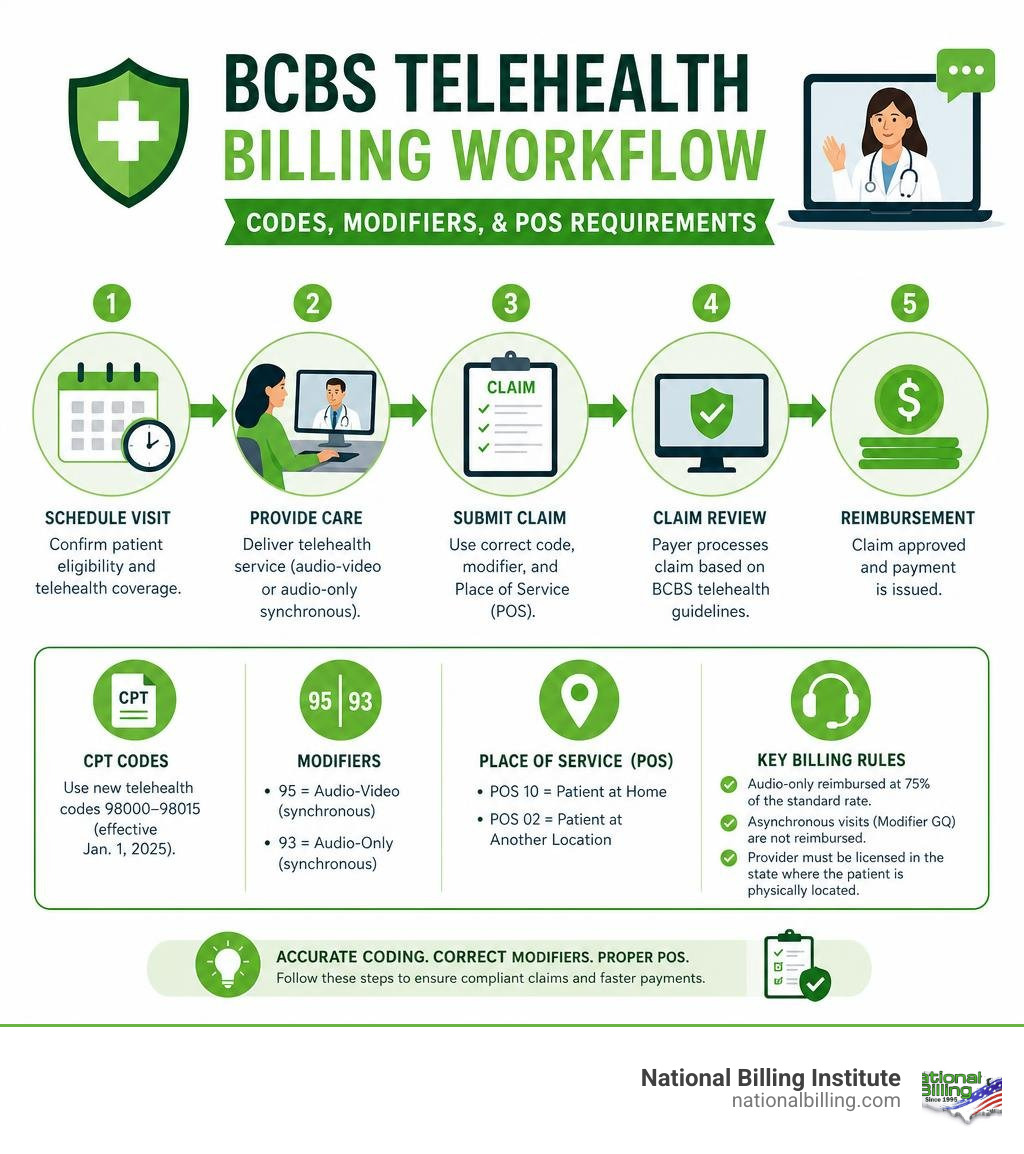
Understanding the Core BCBS Billing Guidelines for Telehealth
To master telehealth billing, we must first look at the foundational policies that govern how Blue Cross Blue Shield (BCBS) plans handle virtual care. Most independent BCBS plans utilize standardized framework documents, most notably the Clinical Payment and Coding Policy CPCP033 and its counterpart, Reimbursement Policy RP033.
These core policy documents outline the payment and coding guidelines for services delivered by an eligible healthcare professional when neither the provider nor the patient is present at the same physical location. However, a critical rule of thumb for any medical biller is the hierarchy of authority:
The Plan Document Governs: If a conflict arises between a clinical payment policy and a member’s specific plan benefit booklet or certificate of coverage, the plan document always wins.
The Provider Contract Rules: If there is a conflict between the policy and your specific provider participation contract, the contract language takes precedence.
When submitting claims, we must ensure our clinical documentation is bulletproof. Providers are expected to use valid code combinations from HIPAA-approved code sets and follow industry-standard coding guidelines, such as the American Medical Association (AMA) CPT Assistant and CMS guidelines. For a deep dive into the foundational mechanics of virtual billing, you can read our comprehensive guide on how to bill for telemedicine visits.
State-by-State Policy Variations: TX, NC, MI, and ND
One of the biggest hurdles we face is that BCBS is not a single entity. It is an association of independent plans, and their clinical payment policies vary significantly by region.
Blue Cross Blue Shield of Texas (BCBSTX): Effective January 1, 2025, BCBSTX updated its Clinical Payment and Coding Policy CPCP033 to align directly with the AMA’s newly established evaluation and management (E/M) telemedicine codes. They determine the appropriate code levels based strictly on medical decision-making (MDM) or the total time spent on the date of the encounter.
Blue Cross NC (North Carolina): Blue Cross NC has established highly specific reimbursement rules, particularly for audio-only services. While they support telehealth as a vital access tool, they reimburse audio-only telehealth at 75% of the standard audio/video or face-to-face allowed rate, reflecting what they view as lower delivery costs and inherent clinical limitations.
Blue Cross Blue Shield of Michigan (BCBSM): BCBSM and Blue Care Network (BCN) took a giant leap on July 1, 2025, by fully deprecating standard in-office E/M codes (99202–99215) for virtual visits. Instead, they require the proprietary and newly adopted telemedicine-specific procedure codes (98000–98015). If you try to submit a 99213 with a telehealth place of service to BCBSM today, it will be denied immediately.
Blue Cross Blue Shield of North Dakota (BCBSND): BCBSND also adopted the new telemedicine-specific code sets. Providers looking to verify coverage or submit claims under these guidelines must consult the specific Telehealth Services Reimbursement Policy and coordinate with BCBSND Provider Services to ensure regional compliance.
Place of Service (POS) Codes: POS 02 vs. POS 10
Choosing the correct Place of Service (POS) code is one of the most common friction points in telehealth billing. The industry has moved to a two-digit system that clearly differentiates where the patient is located during the virtual visit.
POS Code Description Clinical Scenario Originating Site Fee (Q3014) POS 02 Telehealth Provided Other than in Patient's Home Patient is at an originating site (e.g., a clinic, hospital, or nursing facility) receiving care from a distant specialist. Eligible (can be billed by the hosting facility). POS 10 Telehealth Provided in Patient's Home Patient is at their private residence, temporary lodging, or home setting during the virtual encounter. Ineligible (cannot be billed under any circumstances).
Using these codes correctly is vital. For instance, Blue Cross NC requires telehealth services to be reported strictly with either POS 02 or POS 10. If a provider bills POS 10, they cannot bill HCPCS code Q3014 (originating site facility fee) because the provider is not physically hosting the patient in a clinical facility.
Telemedicine Coding Updates: The 98000–98015 Code Series
The year 2025 brought one of the most significant overhauls to E/M coding in a generation. The AMA completely removed the telemedicine star symbol (★) from standard E/M codes (99202–99205 and 99212–99215). This means standard E/M codes are now strictly reserved for face-to-face office visits, unless a payer specifically instructs otherwise.

In their place, the AMA introduced the 98000–98015 code series. This series is designed specifically for synchronous virtual care, split cleanly between audio-video and audio-only services. To prevent denials, your billing team must master these bcbs telehealth billing codes to ensure you are aligning your claims with the correct virtual modalities.
Implementing the 98000–98015 Series under BCBS Billing Guidelines for Telehealth
This code series is divided into distinct categories based on whether the patient is new or established, and whether the technology used is audio-video or audio-only:
New Patient Audio-Video (98000–98003): Used for synchronous, real-time interactive audio and video encounters. Code selection is based on MDM or total time. For example, CPT 98000 requires a minimum of 15 minutes of straightforward MDM on the date of the encounter.
Established Patient Audio-Video (98004–98007): Used for established patients receiving audio-video virtual care. For instance, CPT 98004 requires a minimum of 10 minutes.
New Patient Audio-Only (98008–98011): Specifically for synchronous telephone or audio-only encounters.
Established Patient Audio-Only (98012–98015): For established patients via telephone.
Brief Synchronous Communication (98016): Often referred to as a virtual check-in, this code requires a minimum of 5 minutes of medical discussion. It cannot originate from a related E/M service performed within the previous 7 days, nor can it lead to an E/M service within the next 24 hours (or the soonest available appointment).
Under BCBSM, BCN, and BCBSND, using these codes is mandatory. To see the official policy transition details for Michigan, you can review the New Telemedicine Billing Codes for BCBSM documentation.
What happens if a connection drops mid-session? Our favorite "real-world" scenario: You start a high-definition video visit, but the patient's local cellular connection drops, forcing you to finish the encounter via standard telephone. BCBS guidelines state that you must bill for the service modality that accounted for the majority of the interactive session time. If 15 minutes were spent on video and 5 minutes on standard audio, you bill the audio-video code. If the video failed in the first 2 minutes and you spent 15 minutes on the phone, you must bill the audio-only code.
Audio-Only Telehealth Rules and Reimbursement Rates
Audio-only care is a lifeline for rural populations and tech-challenged patients, but payers scrutinize these claims heavily.
For an audio-only service (98008–98015) to be reimbursable under core BCBS guidelines, the medical discussion or patient observation must exceed a strict 10-minute minimum threshold. Anything less is considered non-billable or must be rolled into a brief virtual check-in.
Furthermore, as noted in the Blue Cross NC guidelines, these services are reimbursed at a reduced rate (75% of the standard allowed amount). To make sure you are selecting the correct code for telephone-only care, refer to our clinical update on telehealth billing codes.
Modifiers, Digital E/M, and Remote Monitoring Guidelines
Modifiers tell the story of the telehealth encounter. They indicate to the payer's adjudication software exactly how the service was delivered, preventing immediate automated rejections.
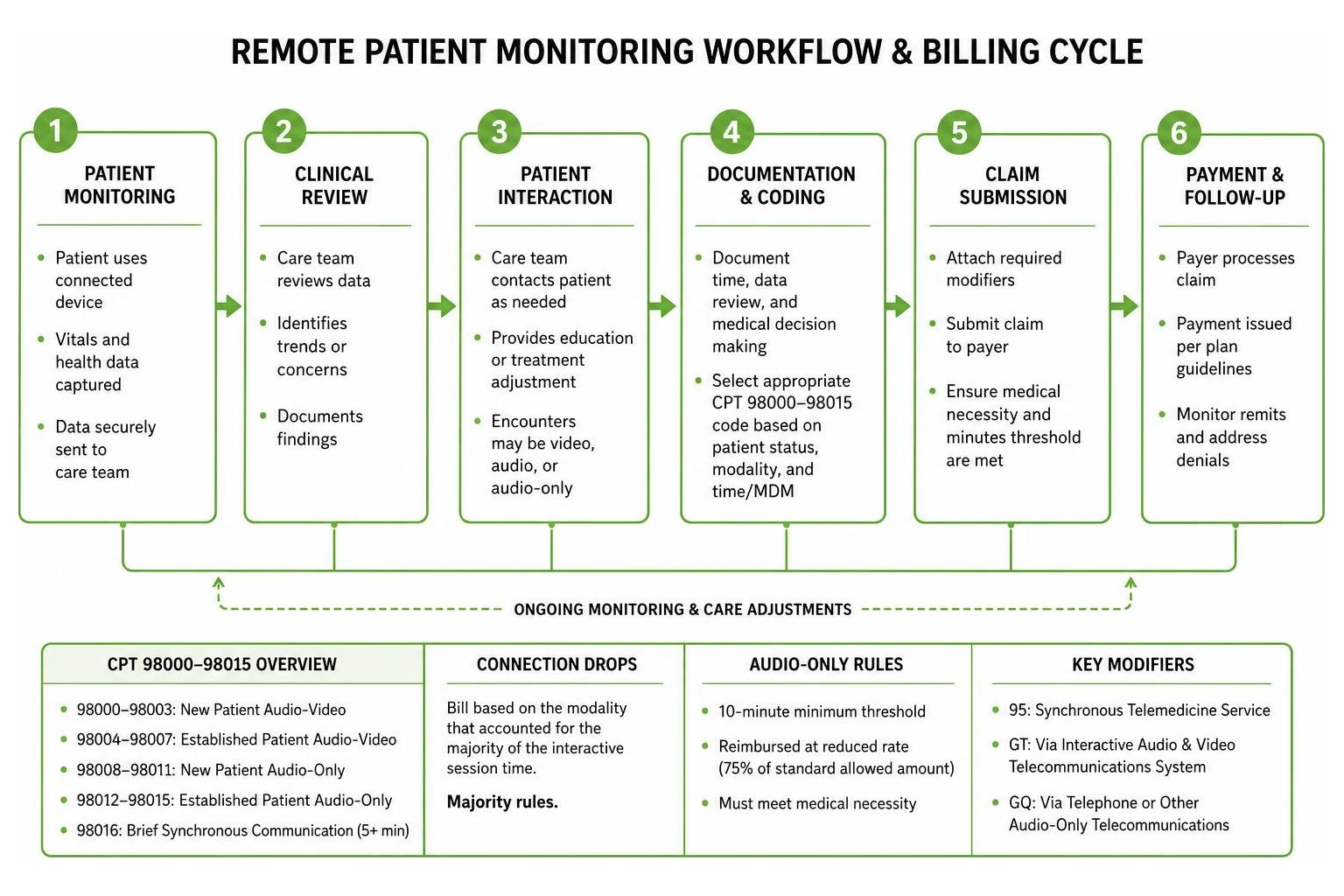
When billing under the RP033 Telemedicine and Telehealth Policy, appending the correct modifier is just as important as selecting the right CPT code. To stay updated on the latest rules, check out our guide on telehealth modifiers 2026.
Essential Modifiers for BCBS Billing Guidelines for Telehealth
Here are the primary modifiers required across various BCBS plans when billing non-telemedicine-specific codes (or when standard codes still require modifiers under specific contracts):
Modifier 95: Indicates a synchronous telemedicine service rendered via a real-time interactive audio-visual telecommunications system.
Modifier 93: Used for synchronous telemedicine services delivered via audio-only technology.
Modifier FQ: Appended when the synchronous service was provided by a practitioner at a distant site to a patient located in their home.
Modifier GQ: Represents asynchronous (store-and-forward) telecommunications. Warning: BCBS Illinois, BCBSTX, and several other major plans explicitly reject asynchronous telecommunication services. Claims submitted with Modifier GQ to these plans will be denied as non-covered.
Modifier GT: Interactive audio and video telecommunication. While widely replaced by Modifier 95, some legacy contracts and state Medicaid programs still require it.
For a comprehensive breakdown of when and how to apply these modifiers to avoid compliance audits, read our dedicated post on telehealth billing modifiers.
Online Digital E/M and Remote Patient Monitoring (RPM/RTM)
Online digital E/M services (CPT 99421–99423) represent digital, asynchronous, screen-based billing (often completed via patient portals). These are not standard virtual visits; they represent cumulative clinical time spent managing a patient over a 7-day period.
Bundling Rules: If an in-person or standard telehealth E/M service occurs within 7 days of the digital initiation (for the same clinical issue), the digital E/M time is bundled into the E/M visit and is not separately reimbursable.
Remote Monitoring (RPM/RTM): Remote Physiologic Monitoring (RPM) and Remote Therapeutic Monitoring (RTM) are excellent tools for chronic disease management. However, BCBS plans have strict rules regarding overlapping services. For example, Blue Cross NC guidelines state that RPM/RTM services are considered incidental to any E/M service performed by the same provider or group practice on the same calendar day. They will not allow separate reimbursement if billed alongside an E/M.
Compliance, Licensing, and Excluded Services
Compliance is the shield that protects your practice from post-payment audits and recoupments. Telehealth crosses physical boundaries, which introduces unique legal and regulatory challenges.
Out-of-State Licensing and Credentialing
The golden rule of telehealth licensing is that the practice of medicine occurs where the patient is physically located at the time of the encounter.
If a provider sitting in our home state of Florida treats a patient who is currently traveling in North Carolina, that provider must be licensed, registered, or otherwise legally authorized to practice medicine in North Carolina. Under North Carolina Senate Bill 780, out-of-state providers treating NC residents must be fully licensed in NC. Failing to meet this requirement violates state medical board rules and will result in immediate claim denials under BCBS guidelines. For information on how these licensing boundaries affect government plans, review our analysis of medicaid telehealth billing.
Security, Consent, and Explicit Telehealth Exclusions
To ensure your telehealth program remains fully compliant, we must address three key areas:
Security & HIPAA: All video and audio platforms used must be fully encrypted and compliant with HIPAA and PCI-DSS standards. Standard public-facing video apps (like FaceTime or public Zoom rooms) do not meet these standards.
Patient Consent: Providers must obtain and document the patient's informed consent specifically for telehealth services. This documentation must reside in the permanent medical record and cover expectations, privacy disclaimers, and potential out-of-pocket costs.
Explicit Exclusions: BCBS plans explicitly exclude several services from telehealth reimbursement:
Text messaging, email, or secure portal messages that do not meet the strict time and clinical criteria of digital E/M codes.
Administrative tasks (such as scheduling, leaving voicemails, or transmitting lab results).
Asynchronous communications (unless specifically carved out by a specialized plan document).
Same-day telehealth visits that occur on the same day as an in-person visit for the same clinical condition by the same provider.
Frequently Asked Questions about BCBS Telehealth Billing
What is the difference between POS 02 and POS 10 for BCBS telehealth?
POS 10 is used when the patient is located in their private home or residence during the virtual encounter. POS 02 is used when the patient is located at a clinical facility, school, or other location outside of their home, while the provider delivers care from a distant site.
Does BCBS reimburse for asynchronous (store-and-forward) telehealth?
Generally, no. Major commercial plans like BCBS Illinois and BCBS Texas explicitly exclude asynchronous telecommunications from reimbursement. Claims submitted with Modifier GQ or asynchronous codes to these plans will be denied. Always check the specific member's plan documents, as some specialized contracts may differ.
Can a provider bill an originating site facility fee (Q3014) if the patient is at home?
No. HCPCS code Q3014 can only be billed by a physical facility (like a clinic or hospital) that is physically hosting the patient and providing the clinical space and equipment for them to connect with an outside specialist. If the patient is at home (POS 10), no originating site fee can be billed.
Conclusion
Navigating the shifting waters of bcbs billing guidelines for telehealth requires constant vigilance, precise coding, and an in-depth understanding of regional policy variations. A single coding oversight can disrupt your cash flow and lead to administrative headaches.
At National Billing, operating out of our 100% USA-based headquarters in Boca Raton, FL, we bring over 30 years of medical billing expertise to your practice. Our specialized team handles everything from AI-automated claims processing to rigorous denial management, helping practices stay compliant while increasing their overall revenue by 15-30%. Let us handle the complexities of telehealth billing so you can focus on what matters most: caring for your patients. More info about National Billing services is just a click away — contact us today for a free consultation!
