Aetna Telehealth Billing Guidelines for 2026 Success
Core Modalities and Eligible Services Under Aetna
Aetna telehealth billing guidelines determine whether your virtual care claims get paid — or denied. Here is a quick-reference summary of what providers need to know for 2026:
Aetna Telehealth Billing: Fast-Reference Summary
Requirement Key Detail Covered modality Two-way synchronous audio-video only (for most services) Primary modifiers 95 (synchronous audio-video), GT (interactive audio-video), G0 (tele-stroke) Place of Service POS 02 (telehealth, not home) or POS 10 (patient's home) Audio-only coverage Limited; generally not covered except select behavioral health and state mandates Asynchronous services Not separately reimbursable; considered incidental to care Transmission fees Q3014 and T1014 are not eligible for separate payment Credentialing Providers must meet Aetna credentialing requirements, including licensure Prior authorization Required for select services; verify via Availity before rendering care
Getting these details wrong is one of the fastest ways to trigger a denial. And with Aetna covering millions of commercial and Medicare Advantage members across the country, the stakes are high for any practice offering virtual care.
Telehealth has grown dramatically — utilization has risen 23 times since 2020 — but reimbursement rules have not gotten simpler. Aetna's policies draw sharp lines between what is covered and what is not, and many providers are still billing with outdated codes or missing the right modifiers entirely.
I'm Olivia Harper, Founder and Denial Management & Reimbursement Specialist at National Billing Institute, and with over 30 years of hands-on revenue cycle experience, I've helped hundreds of practices navigate complex aetna telehealth billing guidelines to reduce denials and protect their revenue. In this guide, I'll walk you through exactly what Aetna requires in 2026 — from eligible modalities and correct coding to documentation, consent, and prior authorization rules.


To get reimbursed by Aetna, you must first understand which communication technologies qualify as covered telehealth modalities. Aetna divides virtual care into synchronous (real-time) and asynchronous (store-and-forward) interactions. Applying the wrong modality to a code is a guaranteed path to a claim rejection.
Synchronous vs. Asynchronous Modalities
Under the Aetna Telemedicine and Direct Patient Contact Payment Policy, synchronous telemedicine is defined as real-time interactive audio and video telecommunications. For commercial plans, both video and audio must be active and functional.
In contrast, asynchronous telecommunication involves "store-and-forward" systems where medical data (like images or recorded histories) is transmitted to a provider who reviews it at a later time.
Aetna has strict guidelines regarding these modalities:
Synchronous Audiovisual: Highly covered across most evaluation and management (E/M) codes, psychiatric services, and therapy codes.
Asynchronous (Store-and-Forward): Considered incidental to the overall episode of care and is not separately payable under commercial plans.
Transmission Fees: Facilities cannot bill separately for transmission fees (such as HCPCS codes Q3014 or T1014). These are bundled as incidental.
Audio-Only (Telephone): Generally excluded from standard commercial reimbursement, except under specific state-mandated guidelines or select behavioral health codes.
Eligible Providers and Specialty Restrictions
Not every healthcare professional can bill for virtual services. To be eligible for reimbursement, you must be an Aetna-participating provider who is credentialed to perform the services in-person.
According to Aetna's standards, credentialing and recredentialing occur every three years. Providers must maintain active, unrestricted state licenses in the state where the patient is located at the time of the encounter.
Eligible specialties and professionals typically include:
Physicians (MD, DO)
Nurse Practitioners (NPs) and Physician Assistants (PAs)
Clinical Psychologists and Licensed Clinical Social Workers (LCSWs)
Physical Therapists (PT), Occupational Therapists (OT), and Speech-Language Pathologists (SLP)
When billing, you must ensure your taxonomy and credentialing details are fully updated in the Aetna system. If you are wondering how these provider rules stack up against other major payers, you can read our guide on How to Bill for Telemedicine Visits to compare policies.
Coding, Modifiers, and POS for Aetna Telehealth Billing Guidelines
Navigating the coding landscape for Aetna requires strict attention to modifiers and Place of Service (POS) codes. Aetna aligns its coding methodologies with CPT, HCPCS, and CMS, but maintains its own unique payment logic for commercial claims.
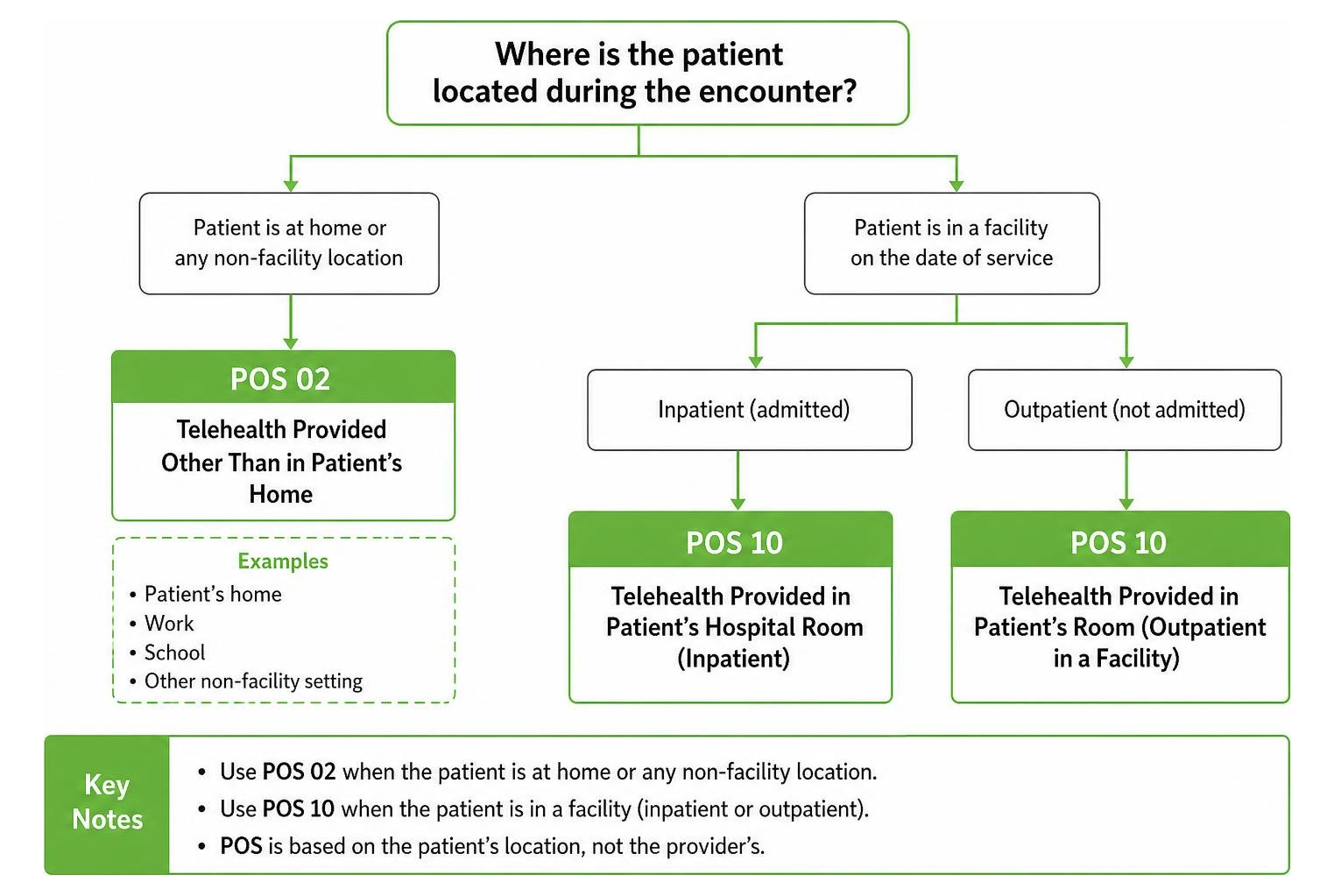
To determine which POS code to apply, use the following decision framework:
Essential Modifiers for Aetna Telehealth Billing Guidelines
Modifiers tell Aetna's claims-processing engines exactly how a service was delivered. Failing to append the correct modifier can lead to a denial stating that an in-person E/M code was billed without physical contact.
The most critical modifiers for Aetna claims include:
Modifier 95: Used for synchronous telemedicine services rendered via real-time interactive audio and video. This is the primary modifier for most commercial E/M claims.
Modifier GT: Used to certify that the service was delivered via interactive audio and video. While CMS has transitioned away from GT in some areas, Aetna still recognizes it on commercial claims to represent synchronous delivery.
Modifier 93: Used for synchronous telemedicine services delivered via audio-only technology. This should only be used where audio-only is explicitly covered (e.g., specific behavioral health codes or under state parity laws).
Modifier G0: Used specifically for tele-stroke services, indicating remote clinical evaluation and treatment of acute stroke symptoms.
For a deeper dive into how these modifiers work across different insurance companies, check out our resource on Telehealth Modifiers.
Place of Service (POS) and Revenue Codes
The Place of Service code indicates the physical location of the patient during the virtual visit. For 2026, Aetna requires providers to distinguish between the patient's home and other settings:
POS Code Description Aetna Application POS 02 Telehealth Provided Other than in Patient's Home Used when the patient is at an originating site (e.g., a clinic, hospital, or nursing facility) during the virtual visit. POS 10 Telehealth Provided in Patient's Home Used when the patient is located in their private residence during the virtual encounter.
For behavioral health facilities billing Intensive Outpatient Programs (IOP) or Partial Hospitalization Programs (PHP), Aetna requires specific revenue codes rather than standard POS codes. These services are strictly televideo-only (unless state mandates override this rule) and should be billed with the appropriate institutional revenue codes. You can learn more about standard coding structures in our guide to Telehealth Billing Codes.
Compliance, Documentation, and Prior Authorization Rules

Compliance is the foundation of a healthy revenue cycle. Aetna regularly audits telehealth medical records to ensure that the billed services match the clinical reality of the encounter.
Documentation and Patient Consent Requirements
A clean telehealth claim is only as good as the underlying medical record. When documenting an Aetna telehealth visit, the note must reflect that the service was equivalent to a face-to-face encounter.
To maintain strict Billing Compliance, your documentation must include:
Informed Consent: Document that the patient gave verbal or written consent for a telehealth visit before the session began.
Modality Details: Explicitly state that the visit was conducted via a secure, HIPAA-compliant "synchronous audio-video connection" (or audio-only, if applicable).
Session Duration: Note the start and stop times, especially for time-based codes like psychotherapy or prolonged E/M services.
Patient and Provider Locations: Document the physical location of both parties (e.g., "Patient located at home in New York; Provider located at clinic in Florida").
Clinical Necessity: Justify why the service was appropriate for a virtual format.
Prior Authorizations, Cost-Sharing, and Directory Updates
Before scheduling a virtual visit, always verify the member's specific benefits. Commercial plans vary widely, and some may require prior authorization for specialized telehealth services, such as neuropsychological testing or ABA therapy.
Prior Authorization: Review Aetna's precertification lists via the Availity portal before rendering care.
Cost-Sharing: Ensure you collect the correct copays, coinsurance, or deductibles. While some plans waived cost-sharing during past public health emergencies, standard cost-sharing applies to commercial telehealth visits in 2026.
Directory Updates: Providers must update their practice profiles in the Aetna directory to indicate whether they offer telehealth. Accurate directory information prevents claims routing errors and ensures compliance with the No Surprises Act.
For comprehensive operational guidelines, reference the official Aetna Provider Manual.
Frequently Asked Questions
Does Aetna reimburse for audio-only telehealth services in 2026?
Aetna's commercial policies generally exclude audio-only telephone consultations from standard reimbursement, viewing them as incidental to care. However, exceptions exist:
Behavioral Health: Select behavioral counseling and opioid treatment codes (e.g., G2086–G2088) allow for audio-only delivery.
Medicare Advantage: Aetna Medicare Advantage plans follow CMS guidelines, which offer broader flexibilities for audio-only E/M and mental health services when billed with Modifier 93 or FQ.
State Mandates: Certain states require private insurers to cover audio-only services under telehealth parity laws.
To ensure you are using the correct codes for telephone and audio-only visits, read our analysis on How to Bill Telemedicine Visits 2025.
Where can I find state-specific Aetna telehealth billing guidelines?
Aetna's national policies are frequently overridden by state-specific insurance mandates. For example:
Texas: Under Texas Insurance Code Chapter 1455, Aetna must cover telemedicine services on par with in-person services, requiring POS 02/10 and Modifiers 95 or GT.
New York: New York mandates audio-only coverage for select Intensive Outpatient Programs (IOP), which overrides Aetna’s standard televideo-only rule.
Because state laws are constantly shifting, always verify local guidelines. You can read more about navigating state programs in our guide to Medicaid Telehealth Billing.
What are the most common reasons for Aetna telehealth claim denials?
The three most common culprits for Aetna telehealth denials are:
Missing or Incorrect Modifiers: Billing an E/M code without Modifier 95 or GT, causing the system to assume it was an undocumented in-person visit.
Invalid Place of Service: Using an in-person POS (like POS 11 for office) instead of POS 02 or POS 10.
Non-Covered Modalities: Billing a televideo-only behavioral health code (like ABA or PHP) as an audio-only service.
If you are struggling with unpaid claims, our resources on Medical Billing Denial Codes can help you identify and resolve these issues.
Conclusion
Mastering aetna telehealth billing guidelines is crucial for securing prompt, accurate reimbursement and avoiding audits in 2026. However, keeping up with shifting modifiers, state mandates, and commercial payment policies can drain your practice’s time and resources.
At National Billing Institute, our 100% USA-based team in Boca Raton, FL, has over 30 years of medical billing experience. We specialize in telemedicine billing, utilizing AI-automated claims processing and aggressive denial management to help healthcare providers increase their revenue by 15% to 30% while maintaining absolute HIPAA compliance.
Let us handle the complexities of telehealth coding so you can focus on what matters most: your patients. Partner with National Billing Institute for Telemedicine Billing Services today, and let's optimize your revenue cycle together.
