A Deep Dive into 95, GT, and GQ Telehealth Modifiers
Why Getting Modifiers for Telehealth Visits Right Can Make or Break Your Reimbursement
Using the correct modifiers for telehealth visits is one of the most critical — and most misunderstood — parts of getting paid for virtual care in 2026. A single wrong modifier, or a missing one, can trigger an immediate denial even when the service itself was completely covered.
Here is a quick-reference summary of the most commonly used telehealth modifiers:
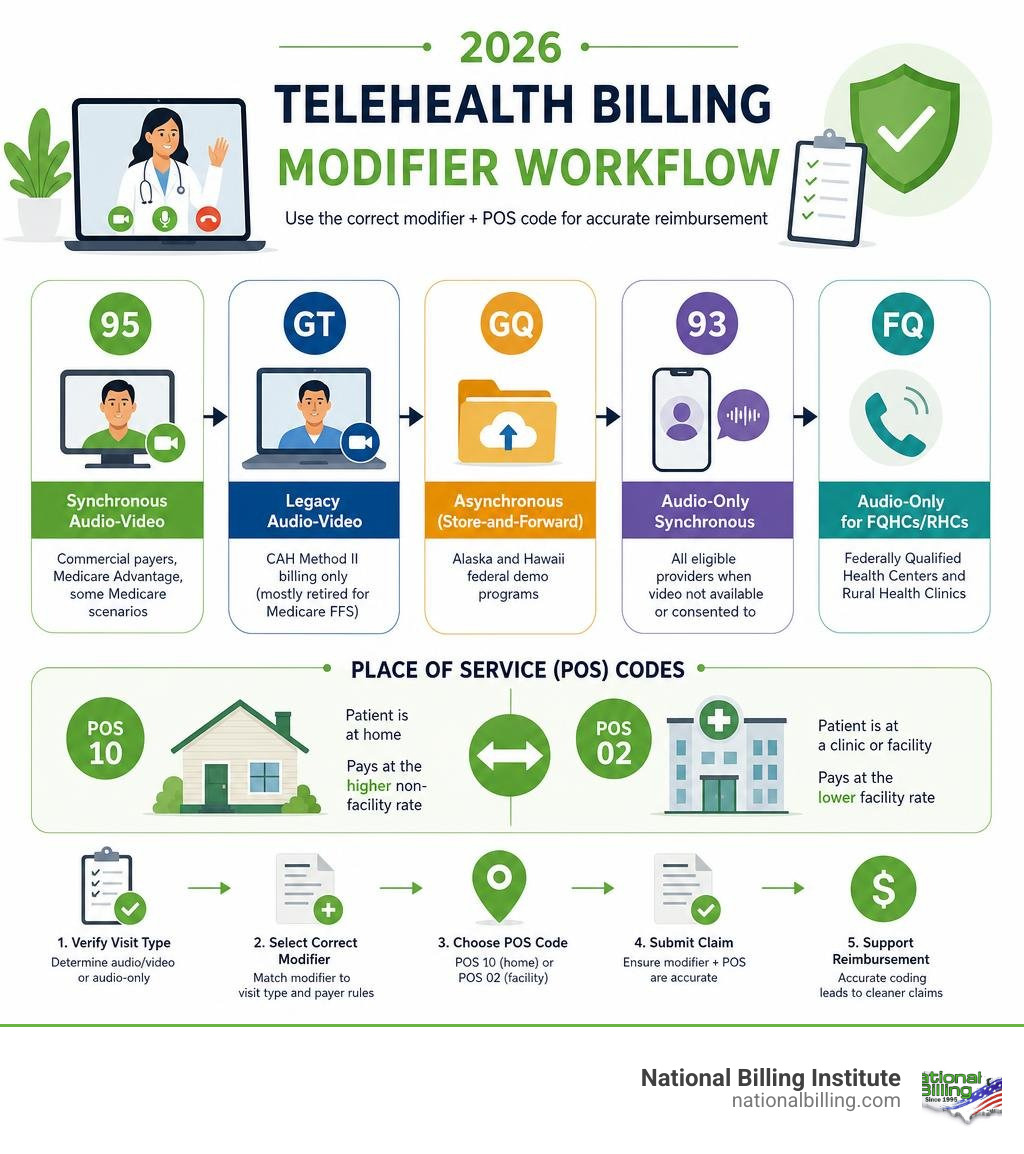
Modifier What It Means Who Uses It 95 Synchronous audio-video telehealth Commercial payers, Medicare Advantage, some Medicare scenarios GT Legacy audio-video modifier CAH Method II billing only (mostly retired for Medicare FFS) GQ Asynchronous (store-and-forward) telehealth Alaska and Hawaii federal demo programs 93 Audio-only synchronous telehealth All eligible providers when video not available or consented to FQ Audio-only for FQHCs and RHCs Federally Qualified Health Centers and Rural Health Clinics
And the two Place of Service codes that work alongside these modifiers:
POS 10 — Patient is at home → pays at the higher non-facility rate
POS 02 — Patient is at a clinic or facility → pays at the lower facility rate
The rules differ significantly depending on whether you are billing original Medicare, Medicare Advantage, commercial insurance, or Medicaid. That layered complexity is exactly where most billing errors happen — and where revenue leaks.
I'm Olivia Harper, Founder and Denial Management & Reimbursement Specialist at National Billing Institute, and with over 30 years of hands-on experience in revenue cycle management, I've helped hundreds of practices eliminate costly errors with modifiers for telehealth visits across every major payer type. This guide breaks down every key modifier, when to use it, and how to protect your reimbursement in 2026.
Understanding the Core Modifiers for Telehealth Visits in 2026
To keep your revenue cycle healthy, we must understand that telehealth modifiers are not "one-size-fits-all" stickers we can slap onto any claim. Payers use these modifiers to verify that the technology used meets their clinical standards and statutory definitions of virtual care.
Using incorrect Telehealth Billing Modifiers is a primary driver of clean claim failures. As of July 2026, the industry has shifted away from temporary pandemic-era shortcuts toward a highly structured, permanent set of Telehealth Modifiers 2026 guidelines.
Modifier 95: Synchronous Audio-Video Services
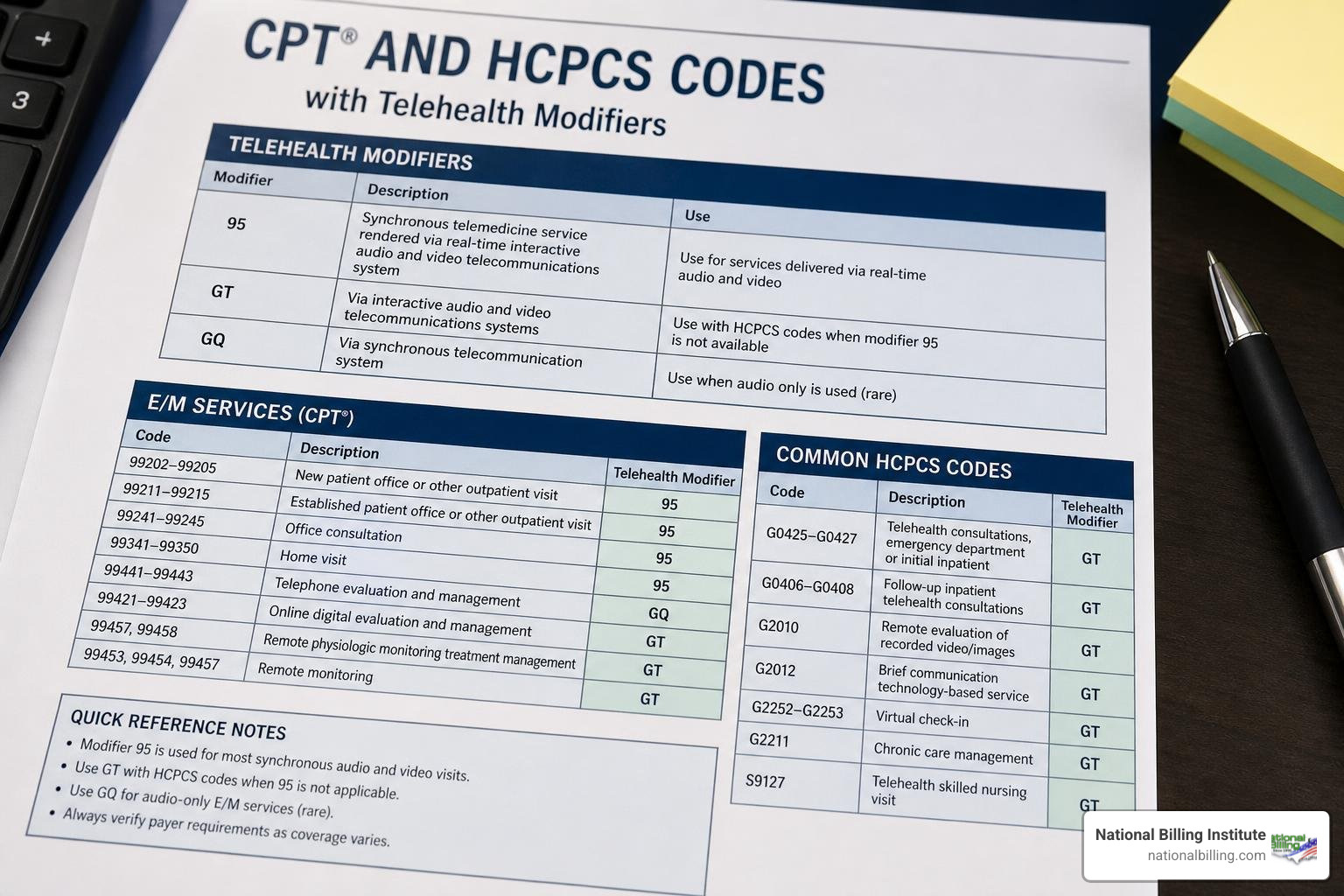
Modifier 95 is defined as a synchronous telemedicine service rendered via a real-time interactive audio and video telecommunications system. It is the most widely recognized telehealth modifier in the United States.
However, there is a catch that trips up many billing teams: Modifier 95 is only applicable to specific codes. According to the American Medical Association (AMA), it should only be appended to codes explicitly listed in Appendix P of the CPT manual.
When billing commercial payers (such as Blue Cross Blue Shield, Aetna, or Cigna) and Medicare Advantage plans, Modifier 95 is usually mandatory when billing traditional Evaluation and Management (E/M) codes (99202–99215) to indicate the visit was virtual. For more details on eligible codes, you can review the Medicare Telehealth Coverage: Eligible Services and Billing Codes | National Telehealth Authority.
Modifier GT: The Legacy of Distant Site Telepresenters
Modifier GT was once the go-to modifier for synchronous telehealth. However, its use has declined dramatically. Medicare officially retired Modifier GT for the vast majority of Part B claims when Place of Service (POS) code 02 was introduced.
Today, you should only use Modifier GT under very specific circumstances, such as when distant site practitioners are billing for telehealth services under Critical Access Hospital (CAH) optional payment Method II. If you default to using Modifier GT on standard Medicare Fee-for-Service (FFS) claims, you are almost guaranteed to receive a swift denial.
Modifier GQ: Asynchronous Store-and-Forward Telehealth
Modifier GQ is used to indicate an asynchronous telehealth service. This refers to "store-and-forward" technology, where clinical data (like X-rays, photos, or pre-recorded videos) is collected and transmitted to a practitioner at a distant site for evaluation at a later time.
Medicare only reimburses asynchronous telehealth under highly restricted federal telemedicine demonstration programs in Alaska and Hawaii. For commercial payers, store-and-forward teledermatology or teleophthalmology is more widely accepted, but you must verify payer-specific policies before appending Modifier GQ.
Audio-Only Telehealth: When to Use Modifier 93 and Modifier FQ
The rules governing audio-only telehealth have tightened significantly. While the convenience of telephone-only visits is undeniable, billing them requires precise modifier usage to comply with Medicare and commercial guidelines.
To understand the complete framework of these changes, we recommend reviewing the official CMS documentation in MLN901705 - Telehealth & Remote Monitoring.
Applying Modifier 93: Audio-Only Modifiers for Telehealth Visits
Modifier 93 is used for synchronous telemedicine services rendered via telephone or other real-time interactive audio-only telecommunications technology.
Under current 2026 rules, Medicare allows audio-only technology for non-behavioral telehealth services through December 31, 2027, but only under strict conditions. The distant site provider must be technically capable of delivering audio-video telehealth, and the audio-only option must be used because the patient is located at home and either cannot access or does not consent to video technology. You must explicitly document this reasoning in the clinical note.
Additionally, be aware that CPT codes 99441–99443 are no longer available for Medicare audio-only services. Instead, Medicare expects you to bill the standard E/M codes with Modifier 93 when the audio-only criteria are met.
Modifier FQ for FQHCs and RHCs
Federally Qualified Health Centers (FQHCs) and Rural Health Clinics (RHCs) follow a completely different set of rules. For these safety-net providers, Modifier FQ is used to report synchronous, audio-only mental or behavioral health services.
Under Medicare rules, FQHCs and RHCs can act as distant site providers for behavioral health. When they deliver these services via telephone, they must append Modifier FQ to indicate that the service was provided using audio-only technology.
Place of Service Codes: How POS 02 and POS 10 Impact Reimbursement
Many practices lose revenue by defaulting to old billing habits. For example, some billing teams still use POS 11 (Office) for telehealth claims. This is a massive compliance risk that can trigger audits and immediate denials.

To bill correctly, we must look at where the patient is physically located during the visit. This is where Pos 10 and POS 02 come into play.
POS 10 vs POS 02: Facility vs Non-Facility Rates
The choice between POS 10 and POS 02 directly dictates your reimbursement rate.
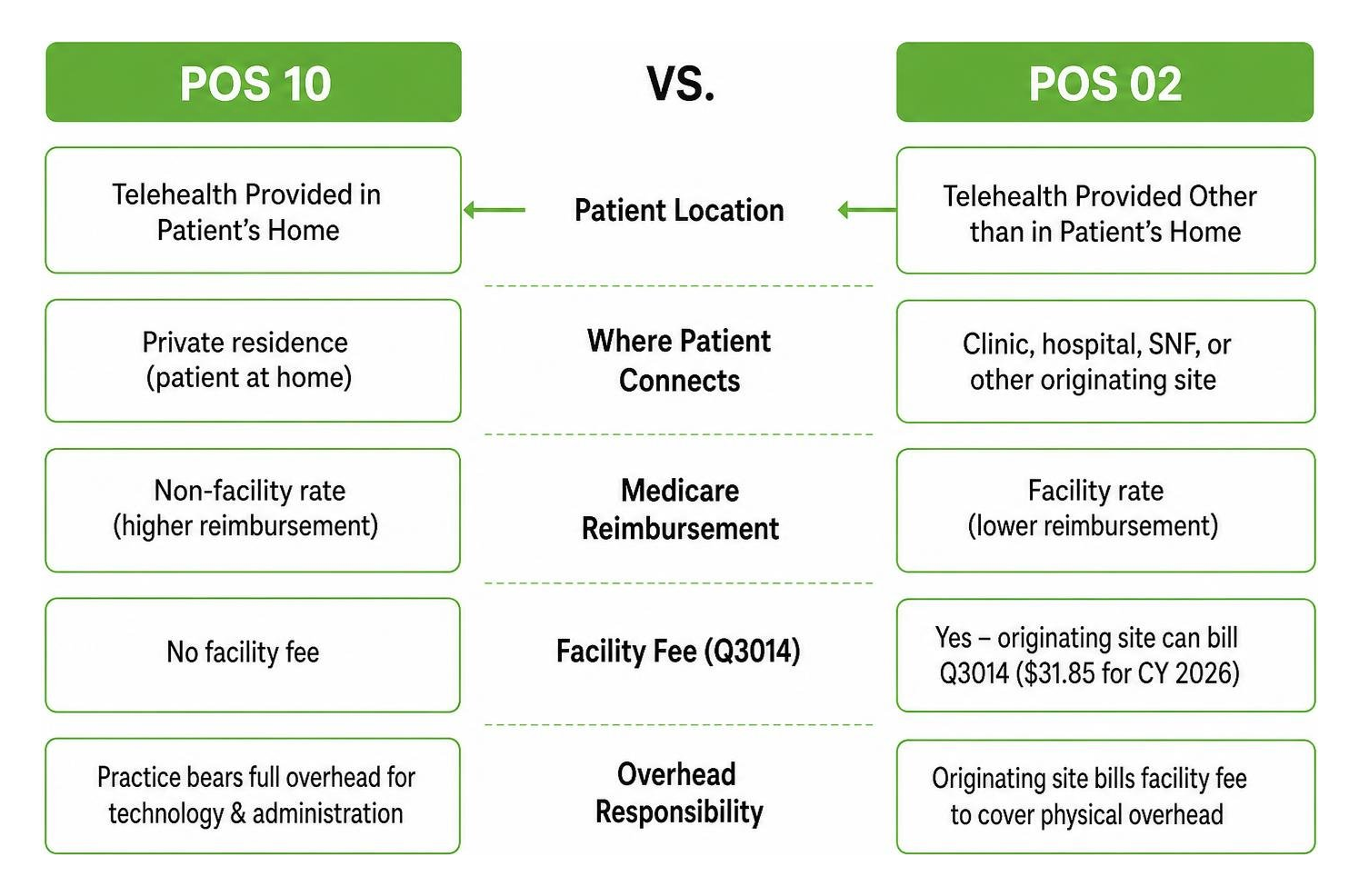
POS 10 (Telehealth Provided in Patient's Home): This code is used when the patient connects to the virtual visit from their private residence. Medicare pays for these services at the non-facility rate, which is higher because it assumes the practice is bearing the full overhead of the technology and administrative support.
POS 02 (Telehealth Provided Other than in Patient's Home): This code is used when the patient is located at an originating site, such as a clinic, hospital, or skilled nursing facility. Medicare pays POS 02 at the facility rate, which is lower because the originating site can bill a separate facility fee (HCPCS code Q3014, reimbursed at $31.85 for CY 2026) to cover their physical overhead.
Payer-Specific Rules for Modifiers for Telehealth Visits
The most common point of confusion is that Medicare FFS and commercial insurers handle modifiers differently:
Medicare Fee-for-Service: Original Medicare relies primarily on the POS codes (02 or 10) to identify telehealth claims. For standard audio-video E/M visits, Medicare FFS does not require Modifier 95. The POS code itself acts as the trigger for telehealth processing.
Commercial Payers and Medicaid: Most commercial carriers (like BCBS, UnitedHealthcare, and Humana) and state Medicaid programs require both the correct POS code and Modifier 95 to process the claim. Some state Medicaid programs have highly specific rules, which you can check via Medicaid Telehealth Billing.
Key Documentation and Compliance Requirements to Avoid Denials
With federal agencies like the Office of Inspector General (OIG) increasing scrutiny on virtual care, thorough documentation is your best defense against audits. High-volume telehealth practices (those billing 90% or more of their total visits via telehealth) face elevated audit risks.
To protect your practice, align your clinical workflows with the official guidelines outlined in Billing and coding Medicare Fee-for-Service claims.
Essential Elements of a Telehealth Clinical Note
Every telehealth medical record must stand on its own. At a minimum, your clinical notes must document:
Mode of Communication: Explicitly state whether the visit was conducted via synchronous audio-video or audio-only (with justification for why video was not used).
Patient Location: Document the physical location of the patient during the encounter (e.g., "Patient connected from their home in Boca Raton, FL").
Provider Location: Document where the practitioner is physically located.
Patient Consent: Document that the patient gave verbal or written consent for a telehealth encounter, including an acknowledgment of any cost-sharing responsibilities.
Time/Complexity: Ensure the documented clinical work supports the level of E/M code billed.
CY 2026 Regulatory Updates and Home Enrollment Rules
The CY 2026 Physician Fee Schedule (PFS) Final Rule brought several important regulatory updates:
Home Enrollment Rules: The pandemic-era waiver that allowed providers to deliver telehealth from their homes using their clinic's enrollment address has ended. Starting January 1, 2026, providers who regularly deliver telehealth from home must separately enroll their home address as a practice location. However, CMS has implemented address suppression rules to protect provider privacy on public directories.
Permanent Additions: CMS has finalized a policy where services will only be added to the Medicare telehealth list on a permanent basis moving forward, removing the "provisional" category. You can stay updated on these specific codes through Cms Telehealth Billing Codes.
Teaching Physicians: Teaching physicians may permanently supervise residents through virtual presence in all teaching settings when the resident is providing telehealth services.
Frequently Asked Questions about Telehealth Modifiers
Does Medicare require Modifier 95 for all telehealth claims?
No. For original Medicare Fee-for-Service, you do not need to append Modifier 95 to standard E/M codes, as Medicare uses POS 10 and POS 02 to identify telehealth. However, Modifier 95 is still required by Medicare for outpatient therapy services provided via telehealth by qualified therapists (PT, OT, SLP) employed by hospitals, and it remains widely required by commercial payers and Medicare Advantage plans.
What is the difference between POS 02 and POS 10?
POS 10 is used when the patient is at home during the telehealth visit and reimburses at the higher non-facility rate. POS 02 is used when the patient is at a clinic, facility, or any location other than their home, reimbursing at the lower facility rate.
Can FQHCs and RHCs bill for audio-only telehealth?
Yes, but primarily for mental and behavioral health services. FQHCs and RHCs must use Modifier FQ on their claims to indicate that a behavioral health visit was conducted via audio-only technology.
Conclusion
Mastering modifiers for telehealth visits requires constant vigilance and an adaptable billing team. Between shifting Medicare deadlines, commercial payer updates, and the strict distinction between POS 10 and POS 02, keeping your clean claim rate high is a full-time job.
At National Billing Institute, we take the guesswork out of virtual care billing. Our 100% USA-based team in Boca Raton, FL, leverages over 30 years of experience and advanced billing technology to deliver the industry's lowest denial rates, full HIPAA compliance, and an average revenue increase of 15% to 30% for our clients.
Let us handle the complexities of telehealth modifiers while you focus on patient care. More info about medical billing services._
