
The Essential Checklist for HIPAA Compliant Medical Billing Services
Why Choosing a HIPAA Compliant Medical Billing Company Can Make or Break Your Practice
Working with a HIPAA compliant medical billing company is one of the most important decisions a healthcare provider can make. Here's what to look for at a glance:
What makes a medical billing company HIPAA compliant?
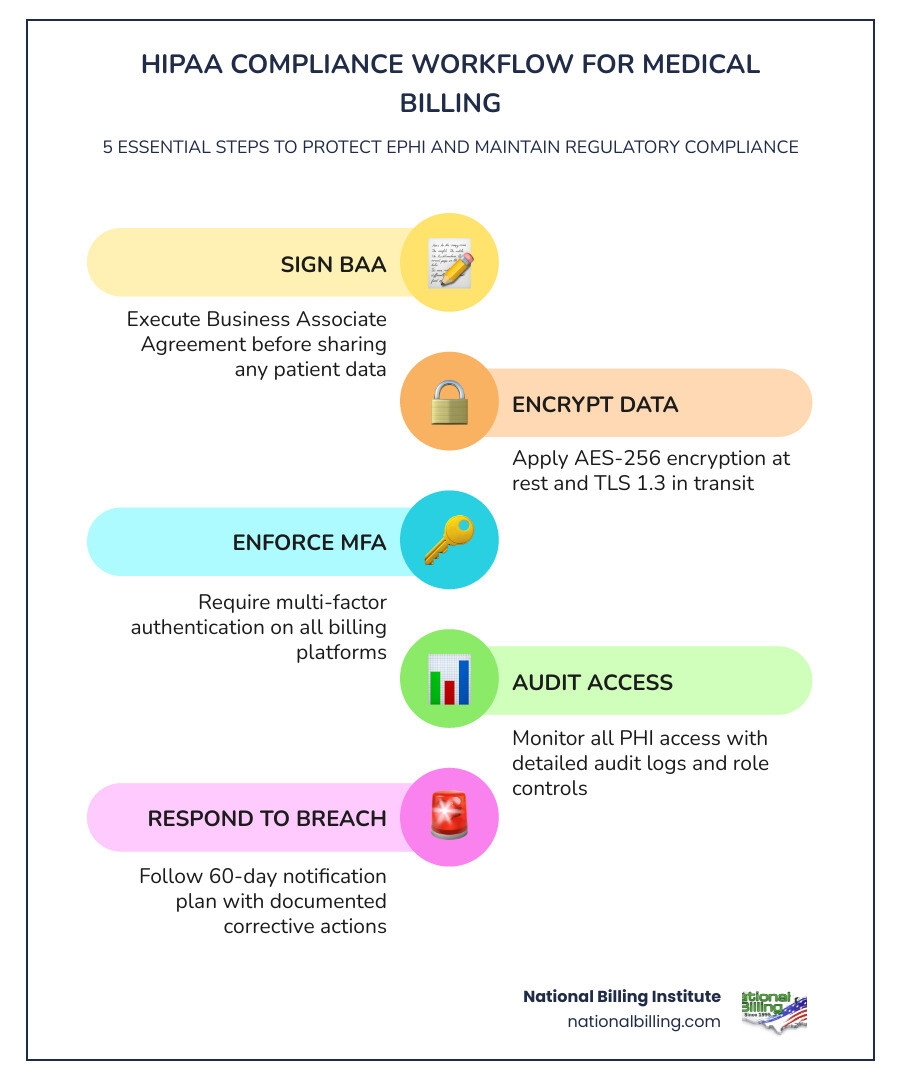
Requirement What to Look For Business Associate Agreement (BAA) Signed before any PHI is shared Data Encryption AES-256 at rest, TLS 1.2/1.3 in transit Multi-Factor Authentication (MFA) Required on all billing platforms Role-Based Access Controls Staff see only what they need Breach Notification Policy Written plan with 60-day notification window Annual Risk Assessments Documented and updated regularly Staff Training Annual HIPAA training for all employees Audit Logs Ongoing monitoring of all PHI access
Healthcare data breaches exposed over 133 million records in 2024. OCR investigations jumped 264% after that year's ransomware surge. And the average practice is already losing 12% of billed revenue to denied claims and billing errors — before any compliance penalty enters the picture.
The financial and legal stakes are not abstract. A single unsecured file transfer can expose thousands of patient records. One Florida billing company learned this the hard way when an unencrypted email transmission exposed 2.7 million patient records — and led to the company's shutdown.
Compliance isn't just a checkbox. It's the foundation your revenue cycle is built on.
I'm Olivia Harper, Founder and Denial Management & Reimbursement Specialist at National Billing Institute — a 100% in-office, HIPAA compliant medical billing company headquartered in Boca Raton, Florida, with over 30 years of experience protecting patient data and maximizing revenue for practices nationwide. In this guide, I'll walk you through exactly what HIPAA compliance looks like in practice, what the 2025-2026 updates require, and how to evaluate any billing partner before you hand over your patients' data.
What HIPAA Compliance Means for Medical Billing Operations
To understand what a hipaa compliant medical billing company actually does, we have to look at how the Health Insurance Portability and Accountability Act intersects with the day-to-day revenue cycle. Every single medical claim contains a goldmine of sensitive data: patient names, Social Security numbers, dates of birth, diagnoses, and treatment codes. In the hands of cybercriminals, this electronic Protected Health Information (ePHI) is highly valuable.
For a billing department, HIPAA compliance is governed by three primary pillars:
The Privacy Rule: This rule dictates how and when patient information can be used or shared. In billing, we apply the "Minimum Necessary" standard. This means a biller should only access the specific health data required to process a claim—not the patient's entire clinical history.
The Security Rule: This sets the national standards for protecting ePHI that is created, received, maintained, or transmitted. It requires specific administrative, physical, and technical safeguards, which we will break down in detail below.
The Breach Notification Rule: If a breach of unsecured PHI occurs, this rule mandates immediate, structured notification protocols to affected patients, the Department of Health and Human Services (HHS), and sometimes the media.
When we process claims, post payments, or manage appeals, ePHI flows across multiple networks. If any link in that chain is weak, the entire system is vulnerable. To dive deeper into how these rules govern daily workflows, explore our detailed guide on medical billing HIPAA compliance.
Why Your Practice Needs a HIPAA Compliant Medical Billing Company
As a healthcare provider, you are a "Covered Entity" under federal law. When you outsource your revenue cycle management, your billing partner becomes a "Business Associate."
Under HIPAA, a Business Associate is directly liable for compliance violations and data breaches. However, this does not absolve the provider of responsibility. If your billing partner suffers a breach due to negligent security practices, your practice's name will be on the front page of the news, your patient relationships will suffer, and you could face joint liability and massive operational disruption.
Before a single claim is sent, a formal Business Associate Agreement (BAA) must be executed. A BAA is a legally binding contract that:
Explicitly states how the billing company will protect ePHI.
Outlines strict breach notification timelines.
Requires the billing partner to return or destroy all PHI once the contract ends.
Without a signed BAA, sharing any patient data is an automatic, severe HIPAA violation. Establishing this legal framework is the very first step in securing outsourced medical billing services in USA that keep your practice safe and audit-ready.
The 2025-2026 HIPAA Security Rule Updates for Billing Providers

The threat landscape is constantly shifting, and regulatory standards must adapt. Following the unprecedented wave of cyberattacks and ransomware incidents in 2024, the Department of Health and Human Services introduced the most significant updates to the HIPAA Security Rule in over a decade. As we navigate 2026, these updates are fully enforced, and any billing company lagging behind is putting your practice at extreme risk.
The core updates that every hipaa compliant medical billing company must implement include:
Mandatory Multi-Factor Authentication (MFA): There are no exceptions to this rule anymore. MFA must be enforced across all practice management systems, EHR platforms, clearinghouses, internal databases, and company email accounts.
Modernized Encryption Standards: Data at rest must be secured using AES-256 encryption. Data in transit must utilize TLS 1.3 (or at minimum TLS 1.2) protocols. Unencrypted emails or unsecured file transfers are strictly prohibited.
Annual Penetration Testing: Billing companies must conduct independent, third-party penetration testing annually to identify and patch security vulnerabilities before hackers can exploit them.
Strict Vendor Oversight: Billing companies must perform documented risk analyses on their own subcontractors and software vendors, ensuring a chain of compliance.
Staying ahead of these requirements is essential for protecting your revenue. You can read more about how we maintain these rigorous standards in our comprehensive overview of billing compliance.
Cybersecurity and Ransomware Protection in Modern Billing
Ransomware is the single greatest operational threat to medical billing today. When a billing system is hit by ransomware, operations grind to a halt. Claims cannot be submitted, payments cannot be posted, and your practice’s cash flow dries up instantly.
A proactive cybersecurity posture is non-negotiable. A compliant billing company must maintain:
Next-Generation Firewalls & Threat Detection: Continuous network monitoring to detect and block suspicious behavior in real-time.
Immutable Data Backups: Daily, encrypted backups stored in offsite, isolated environments. If a system is compromised, immutable backups ensure data can be restored without paying a ransom.
Disaster Recovery and Business Continuity Plans: Documented, tested procedures to ensure billing operations can resume within hours of an incident, protecting your practice from devastating cash flow gaps.
Technical, Administrative, and Physical Safeguards Checklist
To keep patient data completely secure, a billing company must implement a multi-layered defense strategy. HIPAA organizes these requirements into three distinct categories of safeguards:
Technical Safeguards Administrative Safeguards Physical Safeguards Unique User IDs: No shared logins; every action is traceable to an individual. Risk Assessments: Annual, documented security risk analyses. Secure Facilities: Restricted access to physical offices and servers. Automatic Logoffs: Workstations lock automatically after brief inactivity. Staff Training: Annual, mandatory HIPAA training for all personnel. Workstation Security: Screens positioned away from public view. Audit Logs: Permanent records of who viewed, edited, or deleted ePHI. Sanction Policies: Clear consequences for staff who violate security rules. Device Tracking: Encryption and tracking of all company-owned hardware. Data Encryption: AES-256 for resting data; TLS 1.3 for data in transit. Information Access Management: Strict role-based access control policies. Media Disposal: Secure shredding of paper records and destruction of old drives.
Implementing these safeguards is a major undertaking that requires specialized expertise. This is why many practices find peace of mind by partnering with dedicated USA medical billing services that maintain pre-built, fully compliant infrastructures.
Secure Data Transmission and Access Controls
When sending claims to clearinghouses or payers, data must travel securely. We enforce end-to-end encryption and secure virtual private networks (VPNs) to ensure that patient records are never exposed during transmission.
Furthermore, access controls must be granular. A billing specialist working on accounts receivable for cardiology doesn't need access to the clinical notes of a mental health clinic. Through role-based access control (RBAC), we restrict system permissions so employees only see the exact data required for their specific job functions. For more information on secure data handling, you can review our guide on HIPAA-Compliant Medical Billing Services USA.
How to Evaluate a HIPAA Compliant Medical Billing Company

When you are looking to select HIPAA billing services, you cannot simply take a company’s word that they are compliant. You must verify it. Don't be afraid to ask direct, pointed questions during your evaluation process.
A truly hipaa compliant medical billing company will gladly provide:
A copy of their standard Business Associate Agreement.
Proof of recent, annual Security Risk Assessments.
Documentation of their employee HIPAA training program.
Details on their encryption standards and cybersecurity protocols.
Beyond security, look at their operational track record. A secure, compliant billing process naturally leads to higher accuracy. For instance, our team maintains a 98% first-pass clean claim rate and an average accounts receivable of just 24 days. When compliance and operational excellence go hand-in-hand, your practice thrives. Learn more about selecting the right partner in our guide on the best medical billing services USA.
Red Flags of a Non-HIPAA Compliant Medical Billing Company
If you notice any of the following red flags when vetting a billing company, walk away immediately:
Shared Logins: If multiple billers share a single username and password to access your EHR or billing software, it is impossible to audit who did what. This is a massive security risk and a direct compliance violation.
Unencrypted Communications: If they ask you to email patient sheets, demographic info, or superbills via standard, unencrypted email (like Gmail or Yahoo), they are not compliant.
Offshore Subcontracting Without Disclosure: Many billing companies outsource their labor to offshore teams without telling the provider. This introduces massive compliance vulnerabilities, as US privacy laws do not easily enforce jurisdiction abroad.
No OIG Exclusion Checks: Billing companies must regularly check the Office of Inspector General (OIG) exclusion list to ensure none of their staff are barred from participating in federal healthcare programs.
Partnering with a company that exhibits these red flags exposes you to extreme operational and financial danger. To protect your practice, always choose trusted healthcare billing services that prioritize transparency and strict adherence to the law.
Frequently Asked Questions about HIPAA Compliant Billing
What are the financial risks of HIPAA violations in medical billing?
The financial consequences of a HIPAA violation can be devastating. Penalties are structured based on the level of negligence, with fines ranging from $100 to over $2 million per violation category. In 2024 alone, the OCR collected over $2 million in HIPAA violation settlements.
Beyond federal fines, practices face class-action lawsuits from affected patients, the massive cost of forensic IT investigations, and severe reputational damage that can cause patients to flee to competitors. Furthermore, compliance failures often halt billing operations entirely during investigations, leading to immediate cash flow crises.
How should a billing company handle a data breach?
If a data breach occurs, a compliant billing company must act immediately under the Breach Notification Rule. The clock starts ticking the moment the breach is discovered:
Immediate Mitigation: Secure the network, isolate affected systems, and stop further data leakage.
Investigation: Conduct a thorough forensic analysis to determine what data was accessed and which patients were affected.
Notification: Notify the Covered Entity (your practice) without unreasonable delay, and no later than 60 days after discovery.
Reporting: If the breach affects 500 or more individuals, it must be reported to the HHS and prominent media outlets within 60 days.
Documentation: Maintain all records of the breach, investigation, and notifications for a minimum of 6 years.
Why is a USA-based billing team safer for HIPAA compliance?
When your billing is handled entirely onshore, you benefit from consistent legal jurisdiction and direct oversight. Offshore billing operations are incredibly difficult to audit, and foreign workers are not bound by US criminal laws regarding identity theft or medical privacy.
A 100% USA-based team operates under strict domestic legal frameworks, making background checks, physical security audits, and compliance enforcement straightforward and reliable. Discover the benefits of keeping your data on US soil with our HIPAA compliant USA team.
Conclusion
In the modern healthcare landscape, you cannot separate revenue cycle success from data security. A single compliance error can erase years of hard work, while a secure, streamlined billing process can unlock hidden revenue and stabilize your practice's financial future. In fact, most practices miss out on over $100,000 per year in CCM/RPM revenue simply due to incomplete or non-compliant billing processes.
At National Billing Institute, we build security and accuracy into every single workflow from day one. Based in Boca Raton, Florida, our 100% USA-based expert billing team brings over 30 years of experience to your practice. By combining state-of-the-art AI-automated claims processing with rigorous HIPAA safeguards, we consistently deliver the industry’s lowest denial rates and help our clients achieve a 15% to 30% increase in revenue.
Don't leave your practice's security or cash flow to chance. Partner with a hipaa compliant medical billing company that treats your patients' data with the respect it deserves. Get in touch with our expert billing team today, and let's secure your revenue cycle together.
