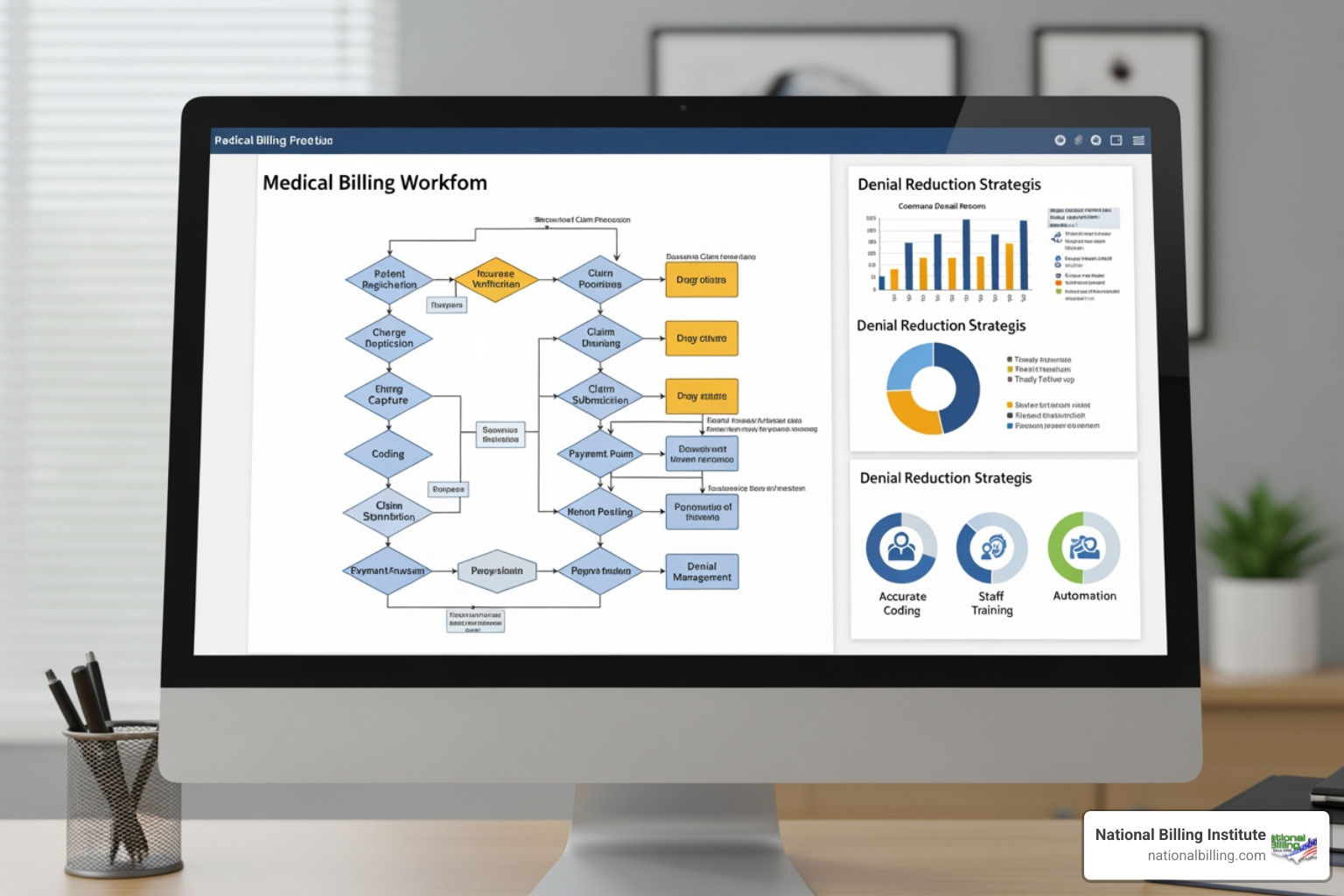
The 3 Pillars of Effective Denial Reduction Strategies
Why Denial Reduction Strategies Determine Your Practice's Financial Health
Implementing effective denial reduction strategies is the single most important step a medical practice can take to stop losing revenue it has already earned.
Here's a quick snapshot of what works:
Verify eligibility before every visit - catches ~30% of denial causes at the source
Use specific ICD-10 codes - avoid unspecified codes ending in 0 or 9
Submit clean claims with real-time scrubbing tools - reduces front-end errors
Act on denials within 48-72 hours - before appeal windows close
Track denial patterns by payer and root cause - enables targeted fixes
Train staff regularly on coding updates and payer rules - prevents repeat errors
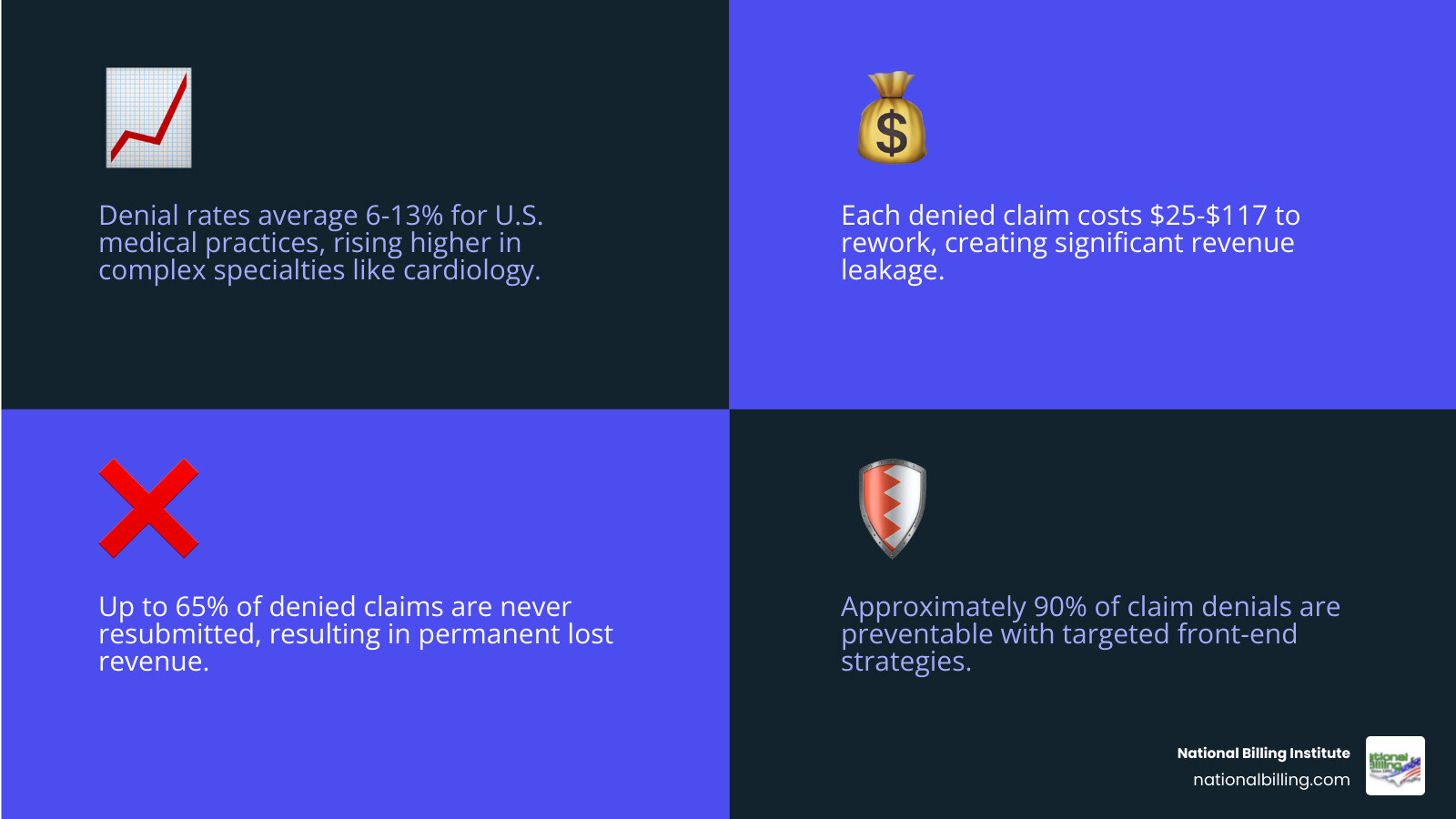
Claim denials are not a minor inconvenience. For most U.S. practices, denial rates run between 6% and 13% — and in complex specialties like cardiology, they climb even higher. Each denied claim costs between $25 and $117 just to rework. And here's the part that stings most: up to 65% of denied claims are never resubmitted at all, meaning that revenue is simply gone.
What makes this especially frustrating is that approximately 90% of denials are preventable. They aren't random. They follow patterns — eligibility failures, missing documentation, coding errors, late submissions — and those patterns can be fixed.
Yet many practices are still stuck in a reactive cycle: chase the denial, appeal, repeat. That approach is expensive, exhausting, and ultimately unsustainable.
I'm Olivia Harper, Founder and Denial Management & Reimbursement Specialist at National Billing Institute, and over my 30+ years helping practices across the country implement proven denial reduction strategies, I've seen how the right systems — not just harder work — are what finally break the denials cycle. In the sections below, I'll walk you through the three core pillars that consistently drive denial rates below 5% and protect the revenue your practice has already worked hard to earn.
Understanding the Financial Impact of Claim Denials
When we talk about claim denials in May 2026, we aren't just talking about administrative paperwork. We are talking about "revenue leakage"—the slow, steady drain of capital that should be funding your clinical staff and patient care. The financial challenge is staggering: medical practices across the United States currently face an average denial rate between 5% and 25%.
Every time a claim is kicked back, the clock starts ticking on your overhead. It costs between $25 and $117 to rework a single claim. If your practice sees a high volume of patients, these "rework costs" can quickly eclipse your profit margins. To make matters worse, nearly 65% of these claims are never resubmitted. This happens because staff are often overwhelmed, or they lack a structured workflow to prioritize high-dollar appeals.
To truly fix this, you have to understand the difference between What is Denial Management in Medical Billing and Denial Prevention. Management is reactive; it’s about chasing money after it’s been refused. Prevention is proactive; it’s about building a fortress around your revenue cycle so the denials never happen in the first place. A well-managed practice should aim for a denial rate below 5% and an appeal success rate above 60%.
Pillar 1: Front-End Denial Reduction Strategies
The most effective denial reduction strategies don't actually start in the billing office—they start at the front desk. Statistics show that nearly 27% to 30% of all denials are traced back to patient registration and eligibility issues. If the foundation of the claim is cracked at the start, no amount of expert coding can save it later.
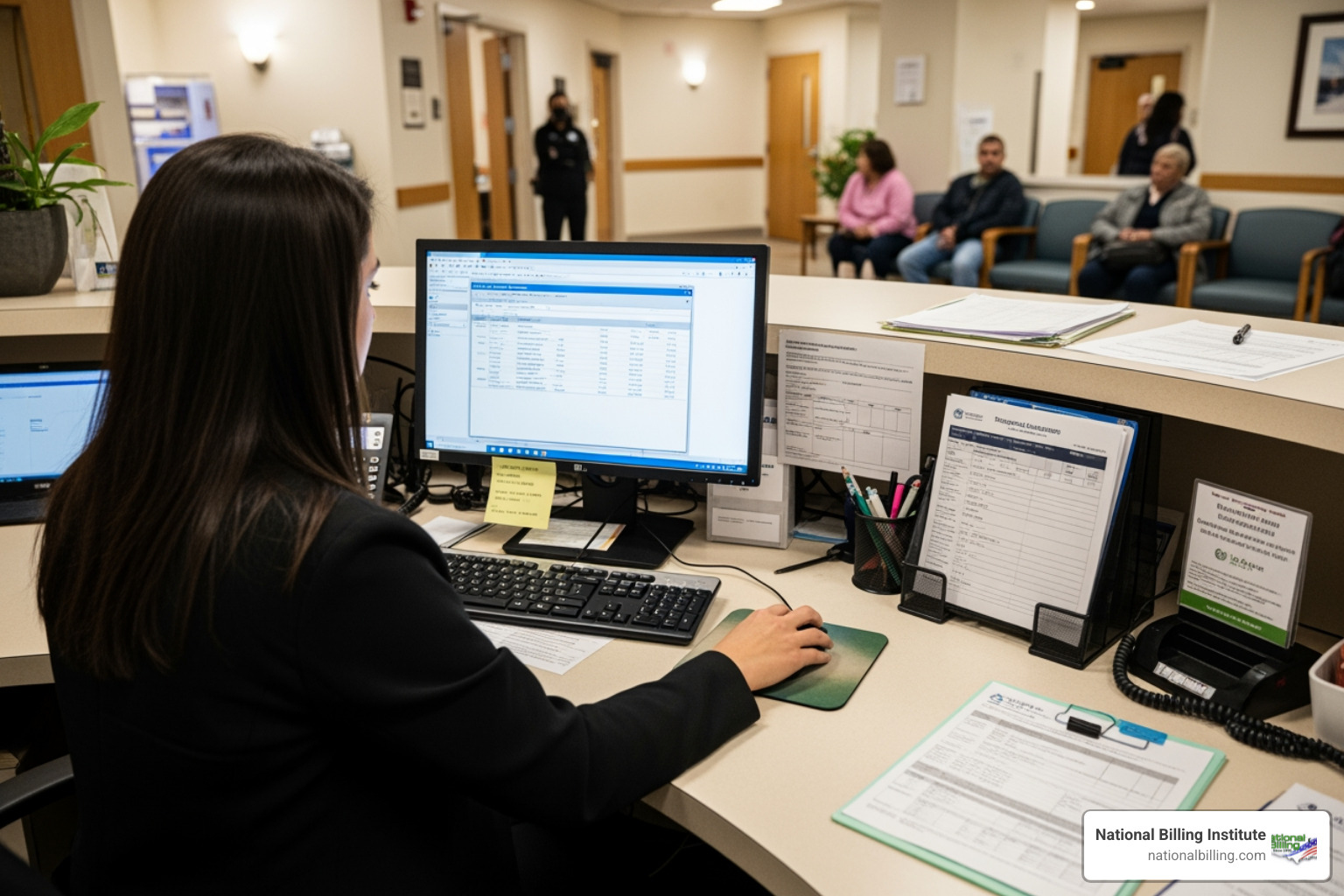
Front-end errors are often "silent killers" of cash flow because they are so basic: a misspelled name, a transposed digit in a policy number, or an expired insurance card. However, in the complex landscape of 2026, insurance nuances have multiplied. Payers frequently change their coverage rules, and a patient who was covered last month might have a different secondary payer or a new "narrow network" restriction today.
Effective Billing Compliance requires that the front-end team acts as the first line of defense, ensuring every piece of data is verified before the patient even sees the provider.
Optimizing Registration for Denial Reduction Strategies
Data integrity is the heartbeat of a healthy revenue cycle. We recommend moving away from manual data entry wherever possible, as it is inherently error-prone. Even the most attentive staff member can make a mistake during a busy Monday morning rush.
To optimize registration, practices should:
Implement Real-Time Verification: Don't wait for the claim to fail. Verify eligibility at three points: when the appointment is booked, 48 hours before the visit, and at the time of check-in.
Standardize Data Capture: Ensure names match the insurance card exactly. Small discrepancies (e.g., "Jon" vs. "Jonathan") are common triggers for automated payer rejections.
Scan and Update: Always scan the front and back of insurance cards. Payers often change the "claims submission address," and using an old one leads to "timely filing" denials.
Pre-Service Authorization and Coverage Identification
One of the most frustrating denials is the "No Authorization" rejection. You provided the service, the patient needed the care, but because a digital "permission slip" wasn't obtained, the payer refuses to pay.
With the rise of FHIR-compliant APIs, practices now have better tools to integrate real-time payer data. These tools can flag services that require prior authorization instantly. Proactive communication with the patient is also key; if a service isn't covered or requires a high co-pay, discussing this upfront improves patient engagement and collection rates. By identifying coverage gaps early, you prevent the "surprise" denials that damage both your bank account and your patient relationships.
Pillar 2: Clinical Documentation and Coding Precision
Once the patient is in the exam room, the focus shifts to clinical documentation. In 2026, payers are using increasingly sophisticated AI to scan your notes for "medical necessity." If your documentation doesn't explicitly justify the level of service billed, the claim will be denied.
Coding Element Impact of Low Specificity Benefit of High Specificity ICD-10 Codes Codes ending in 0 or 9 (unspecified) often trigger audits. Demonstrates exact diagnosis, reducing "medical necessity" denials. Modifiers Incorrect use (e.g., Modifier 25) leads to automatic rejections. Ensures payment for separate, significant services on the same day. NCCI Edits "Unbundling" services results in loss of revenue for legitimate work. Proper bundling follows federal guidelines and prevents fraud flags.
Investing in Denial Reduction Services often involves a deep dive into Clinical Documentation Improvement (CDI). Clean claim rates typically increase by 20–30% when practices invest in regular coder training and documentation reviews.
Aligning Clinicians and Coders for Denial Reduction Strategies
There is often a "language barrier" between doctors and billers. A clinician thinks in terms of patient health, while a coder thinks in terms of billable rules. To bridge this gap, we suggest:
Documentation Audits: Conduct monthly reviews of high-volume procedures to see if the notes actually support the codes being billed.
Education over Correction: Instead of just fixing a code, explain to the provider why a specific phrase (like "acute vs. chronic") is needed to secure payment.
Specialty-Specific Rules: A urologist and a cardiologist face very different payer hurdles. Documentation must be tailored to the specific "Local Coverage Determinations" (LCDs) of your region.
Reducing Errors Through Specialty-Specific Coding
Generic billing services often struggle with complex specialties. For example, cardiology billing has a much higher denial rate due to the intricacy of vascular procedures and the specific modifiers required.
Accuracy isn't just about the primary code; it's about the "modifiers"—those two-digit additions that tell the payer a service was unique. We've found that practices using certified specialty coders see a significant drop in denials. Regular, continuous education is mandatory because CPT and ICD-10 codes are updated annually. If your team is using 2025 logic in 2026, you are essentially leaving money on the table.
Pillar 3: Leveraging AI and Automation in Denial Management
The "new normal" in 2026 involves payers using AI to deny claims faster than ever. To keep up, providers must fight fire with fire. Technology and automation are no longer "optional" luxuries; they are foundational to a resilient revenue cycle.
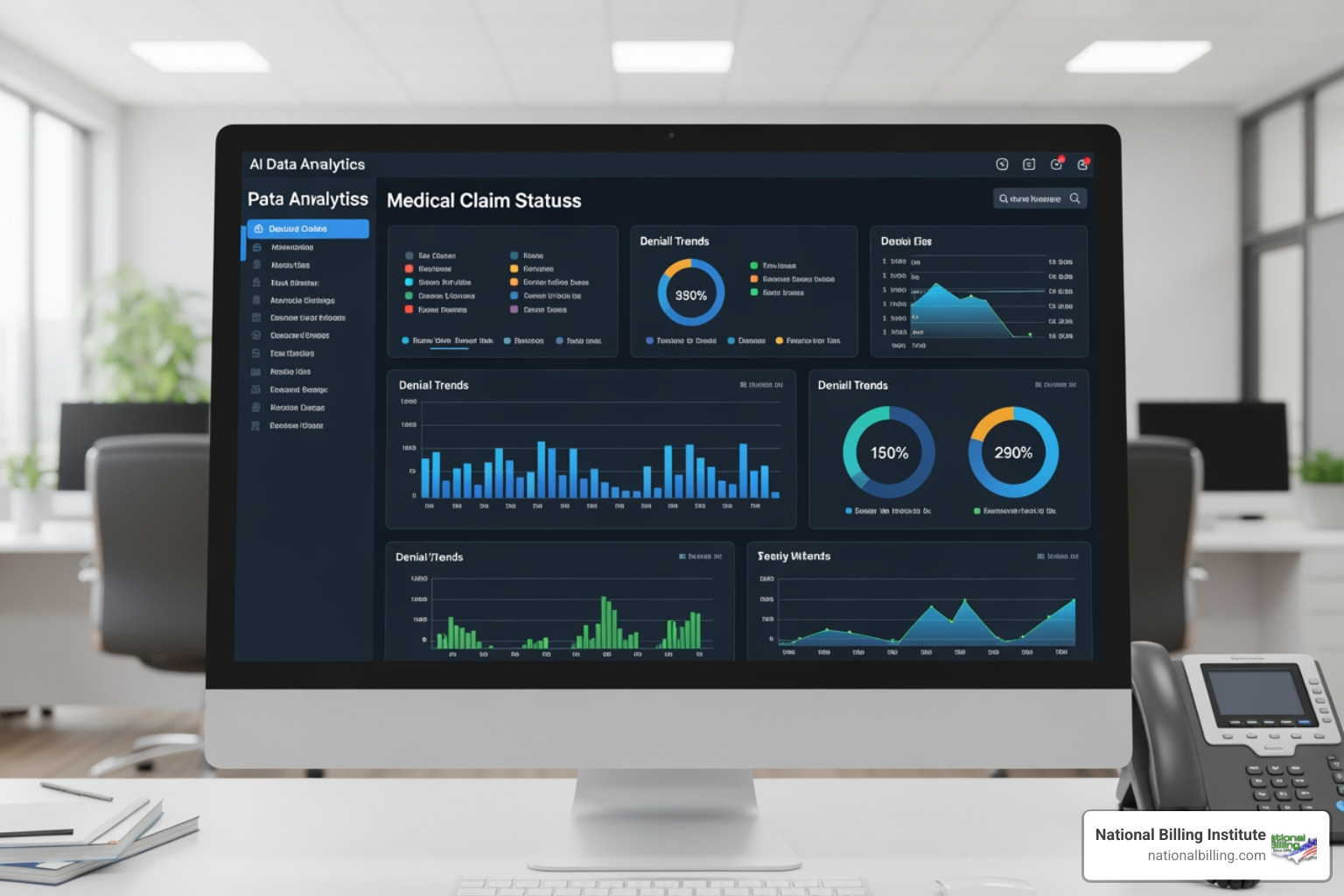
By using predictive analytics, we can identify which claims are likely to be denied before they are even sent. Machine learning algorithms can scan millions of historical claims to find the "hidden" patterns that human eyes might miss—such as a specific payer consistently denying a specific code on Tuesdays (it happens more than you'd think!).
Countering AI-Driven Payer Denials
Payers are now deploying automated "medical necessity" reviews. This has led to a surge in denials despite thorough documentation. To counter this, practices should:
Use Algorithmic Analysis: Surface emerging denial trends across different payers. If a payer suddenly changes their "timely filing" window or starts denying a common modifier, you need to know now, not in three months.
Data Sharing and Negotiation: When you have hard data, you have leverage. Use your denial analytics to negotiate better terms with payers during contract renewals.
Payer Engagement: Hold monthly meetings with payer representatives to compare narratives. If your data shows a 98% clean claim rate but they report 85%, you need to resolve that discrepancy.
Workflow Automation and Prioritization
Not all denials are created equal. A $5,000 surgical denial is more urgent than a $50 lab fee rejection. However, many staff members work through their "denial queue" in chronological order. This is a mistake.
Effective denial reduction strategies use automation to:
Prioritize by Value: Automatically move high-dollar or high-probability-of-success claims to the top of the list.
Monitor Timely Filing: Use automated alerts to ensure you never miss a deadline. Medicare Appeal Timely Filing windows are strict, and Untimely Filing in Medical Billing is the most frustrating way to lose money.
Automated Resubmission: For simple "missing info" denials, RPA (Robotic Process Automation) can pull the missing data and resubmit the claim without human intervention, reducing the "cost to collect."
Frequently Asked Questions about Denial Reduction
What are the most common root causes of claim denials?
The "Big Three" are eligibility/registration errors (30%), missing or incomplete documentation, and coding inaccuracies (specifically unbundling or incorrect modifiers). Timely filing and lack of prior authorization also rank high. Interestingly, nearly 90% of these causes are entirely preventable with better front-end processes and staff training.
How does AI improve the clean claim rate?
AI acts as a "super-scrubber." While traditional scrubbers look for simple errors, AI tools use "Deep Learning" trained on hundreds of millions of claims to predict denials. It can flag a claim for "likely denial" because it recognizes a pattern of rejection for that specific provider-payer-code combination, allowing you to fix it before submission.
When should a practice consider outsourcing denial mitigation?
If your denial rate is consistently above 10%, or if your staff is so bogged down in "chasing" old claims that they can't focus on new billing, it's time to look for help. Outsourcing to a specialized team can often recover up to 85% of denied claims, compared to the 55% recovery rate typical of overstretched internal teams.
Conclusion
Breaking the cycle of claim denials requires a shift from reactive "chasing" to a proactive, three-pillared strategy. By focusing on front-end data integrity, clinical documentation precision, and the smart application of AI and automation, your practice can transform its financial health.
At National Billing Institute, we’ve spent over 30 years perfecting these denial reduction strategies. Our 100% USA-based team in Boca Raton, FL, combines deep industry expertise with cutting-edge AI-automated processing to help healthcare providers see a 15-30% increase in revenue. We don't just manage your denials—we work to eliminate them, ensuring your practice remains HIPAA-compliant and financially resilient in an increasingly complex environment.
Ready to see how much revenue you could be recovering? Explore our full suite of Services and let us help you build a more profitable future today.
