
How to Master Healthcare HIPAA Compliance Without Losing Your Mind
What Healthcare HIPAA Compliance Actually Means (And Why It Matters)
Healthcare HIPAA compliance is the ongoing practice of following federal rules that protect patients' private health information — and it applies to every provider, insurer, and vendor that touches that data.
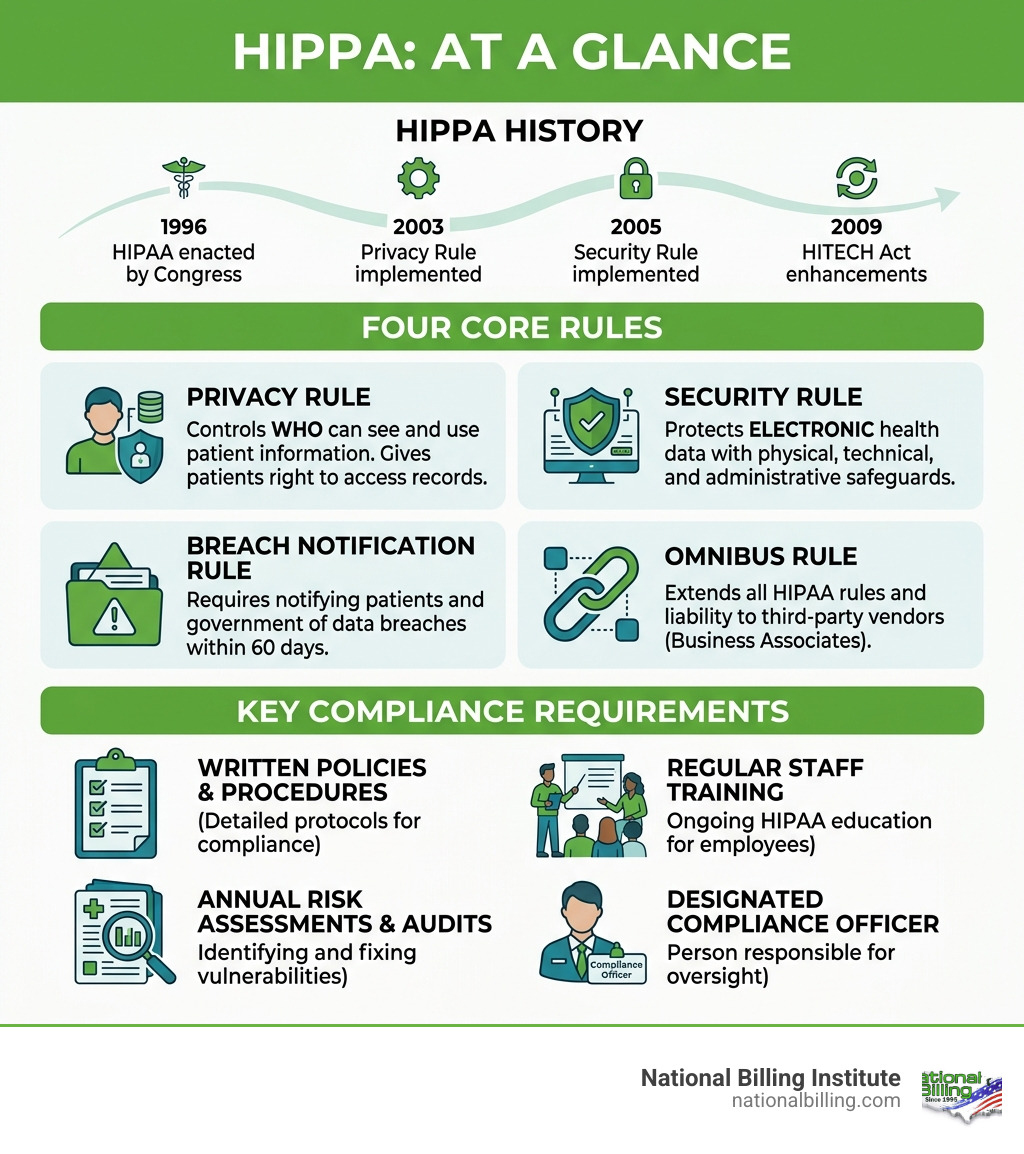
Here is a quick overview of what HIPAA compliance requires:
Requirement What It Means Privacy Rule Controls who can see and use patient health information Security Rule Protects electronic health data with physical and technical safeguards Breach Notification Rule Requires notifying patients and the government within 60 days of a data breach Omnibus Rule Extends all rules to third-party vendors (business associates) Compliance Program Written policies, staff training, risk audits, and a designated compliance officer
The stakes are real. Over 176 million patients in the US have had their protected health information (PHI) exposed in breaches — and most of those breaches were caused not by hackers, but by employee negligence. The US Department of Health and Human Services (HHS) has received more than 100,000 HIPAA violation complaints and investigated over 20,000 cases. Fines range from $100 to $50,000 per incident, and more than $40 million in penalties have been levied since 2016 alone.
HIPAA is not a one-time checklist. It is a living set of obligations that every healthcare organization must maintain continuously — or face serious financial and legal consequences.
I'm Olivia Harper, Founder of National Billing Institute, and with over 30 years of hands-on experience in medical revenue cycle management, healthcare HIPAA compliance has been a cornerstone of every billing process we've built. In this guide, I'll break down everything your practice needs to know — clearly, practically, and without the legal jargon.
The Core Pillars of Healthcare HIPAA Compliance
When we talk about healthcare HIPAA compliance, we are really talking about a framework built on four main pillars. These rules were designed to balance the need for patient privacy with the need for high-quality medical care and efficient data exchange.
The Privacy Rule: This is the "who, what, and where" of health data. It sets national standards for when and how Protected Health Information (PHI) can be used or shared. It also gives patients the right to see and get a copy of their health records. You can find the full details at The HIPAA Privacy Rule | HHS.gov.
The Security Rule: While the Privacy Rule covers all PHI (paper, oral, and electronic), the Security Rule focuses specifically on electronic PHI (e-PHI). It requires us to use administrative, physical, and technical safeguards to keep that data secure.
The Breach Notification Rule: If things go wrong and data is exposed, this rule tells us exactly how to handle it. We must notify affected individuals, the Secretary of HHS, and sometimes the media.
The Omnibus Rule: This 2013 update was a game-changer. It officially extended HIPAA requirements to "Business Associates" (like us at National Billing) and increased the penalties for non-compliance.
Understanding PHI and e-PHI
To master healthcare HIPAA compliance, we first have to identify exactly what we are protecting. Protected Health Information (PHI) is any "individually identifiable" health information. This includes 18 specific identifiers that, when linked to health data, make it PHI:
Names and full-face photos
All geographic subdivisions smaller than a state (addresses, zip codes)
All elements of dates (except year) related to an individual
Telephone and fax numbers
Email addresses
Social Security numbers
Medical record numbers
Health plan beneficiary numbers
Account numbers
Certificate/license numbers
Vehicle identifiers and serial numbers (including license plates)
Device identifiers and serial numbers
Web URLs and IP addresses
Biometric identifiers (fingerprints, voiceprints)
When this information is stored or transmitted digitally—like in your EHR or through our AI-automated claims processing—it becomes e-PHI. Fun fact: medical data is currently worth three times more than credit card numbers on the black market because it’s much harder to "cancel" a medical history than it is to cancel a Visa card. This is why our HIPAA Compliant USA Team treats every byte of data with extreme care.
Covered Entities vs. Business Associates
Not everyone is subject to HIPAA, but if you're reading this, you probably are. The law divides regulated groups into two categories:
Covered Entities (CEs): These are healthcare providers (doctors, dentists, clinics), health plans (insurance companies, HMOs), and healthcare clearinghouses. If you transmit health information electronically in connection with a transaction (like filing a claim), you are a Covered Entity.
Business Associates (BAs): These are third-party vendors that handle PHI on behalf of a Covered Entity. This includes billing companies, IT providers, cloud storage vendors, and even legal consultants.
One of the most common mistakes we see is a provider forgetting to sign a Business Associate Agreement (BAA) with their vendors. Without a BAA, you are technically in violation of HIPAA the moment you share patient data with that vendor. At National Billing, we prioritize Billing Compliance by ensuring all our contracts and sub-contracts are fully HIPAA-aligned.
Safeguarding PHI: Administrative, Physical, and Technical Requirements
The Security Rule doesn't just say "protect the data"; it gives us a roadmap through three types of safeguards. Think of these as the locks on your digital and physical doors.

Essential Safeguards for Healthcare HIPAA Compliance
To stay compliant, your organization needs to address all three areas. It's not enough to have a great firewall (Technical) if your front desk leaves patient charts sitting in the waiting room (Physical).
Safeguard Category Key Requirements Examples in Practice Administrative Policies, training, and risk analysis Conducting an annual risk assessment; designating a Privacy Officer. Physical Facility access and workstation security Using badge-entry for the office; positioning monitors so patients can't see them. Technical Encryption, access controls, and audit logs Using AES-256 encryption; requiring unique user IDs and multi-factor authentication (MFA).
The The Security Rule | HHS.gov emphasizes that these safeguards should be "reasonable and appropriate" for your specific organization. A small clinic in Boca Raton might have different physical needs than a massive hospital system, but the core requirement to protect the data remains the same.
Pro-Tip: Don't just set it and forget it. A security risk assessment isn't a one-time event; it’s an annual necessity. We've seen practices get fined simply because they hadn't updated their risk analysis in three years, even though they hadn't had a breach!
Managing Breaches and Avoiding Costly Violations
Even with the best safeguards, incidents can happen. A laptop is stolen from a car, an unencrypted email is sent to the wrong person, or a disgruntled employee snoops on a celebrity's file. How you respond to these moments determines whether you face a minor slap on the wrist or a multi-million dollar fine.
Common Violations and Penalties
Most healthcare HIPAA compliance violations aren't the result of sophisticated international hacking. They are the result of simple human error.
Negligence: A cardiac monitor vendor was once fined $2.5 million because a laptop containing hundreds of records was stolen from a car.
Ignoring Rights: Cignet Health was fined $4.3 million for simply ignoring patient requests to see their own records.
Social Media: We’ve seen employees fired and practices fined because a staff member posted a "stressful day" photo on Facebook that accidentally showed a patient’s name on a chart in the background.
The penalties are structured in tiers based on the level of negligence:
Tier 1: Unaware of the violation (and couldn't have known) — $100 to $50,000 per incident.
Tier 2: Reasonable cause (not willful neglect) — $1,000 to $50,000 per incident.
Tier 3: Willful neglect (but corrected within 30 days) — $10,000 to $50,000 per incident.
Tier 4: Willful neglect (and NOT corrected) — $50,000 per incident, up to $1.5 million per year.
And don't forget the "Wall of Shame." Any breach affecting 500 or more individuals must be posted on the HHS Breach Notification Portal. This is a permanent, public archive that can destroy a practice's reputation faster than any fine.
Permitted Uses and Disclosures
The good news is that HIPAA isn't meant to stop you from doing your job. You don't need a signed authorization for every single thing. There are 12 "national priority purposes" where you can share PHI without patient consent, but the most common are known as TPO:
Treatment: Sharing info with a specialist or a hospital to coordinate care.
Payment: Sharing info with us (your billing team) or an insurance company to get your claims paid.
Operations: Using data for internal quality audits or staff training.
There are also legal exceptions for public health reporting, such as reporting child abuse, gunshot wounds, or certain infectious diseases to the authorities.

Building an Effective Compliance Program
If you want to master healthcare HIPAA compliance "without losing your mind," you have to stop thinking of it as a set of rules and start thinking of it as a "living culture." It’s not a binder on a shelf; it’s how your team breathes.
Seven Elements of Healthcare HIPAA Compliance
The Office of Inspector General (OIG) has outlined seven elements that make a compliance program "effective." If the OCR (Office for Civil Rights) ever audits you, these are the seven things they will look for:
Written Policies and Procedures: You need clear, customized standards of conduct. Don't just buy a generic template; make sure it reflects how your Boca Raton office actually operates.
Designated Compliance Officer: Someone needs to be the "buck stops here" person for HIPAA. This person should have the authority to make changes.
Effective Training: Annual training is the bare minimum. You should have ongoing "micro-learning" sessions to keep security top-of-mind for your staff.
Effective Communication: Your team needs a way to report potential violations anonymously without fear of retaliation.
Internal Monitoring and Auditing: You should be your own toughest critic. Conduct regular self-audits to find gaps before a regulator does.
Disciplinary Guidelines: If an employee violates HIPAA, there must be consequences that are applied fairly across the board.
Prompt Response and Corrective Action: When a gap is found, fix it immediately and document exactly how you fixed it.
Frequently Asked Questions about Healthcare HIPAA Compliance
What is the difference between the Privacy Rule and the Security Rule?
The Privacy Rule is broad—it covers all forms of PHI (paper, oral, and electronic) and focuses on who has the right to see it. The Security Rule is narrow—it only covers electronic PHI (e-PHI) and focuses on the technical and physical ways we keep that digital data safe.
How long do I have to report a HIPAA breach?
Under the Breach Notification Rule, you must notify affected individuals "without unreasonable delay" and no later than 60 days after the discovery of the breach. If the breach affects more than 500 people, you must also notify the Secretary of HHS and the media within that same 60-day window. Smaller breaches can often be reported annually to HHS.
Can I share PHI with a patient's family members?
Yes, but with caveats. You can share relevant information with family or friends involved in a patient's care if the patient agrees or doesn't object. If the patient is unconscious or in an emergency, you can use your professional judgment to share only what is necessary, provided it's in the patient's best interest.
Conclusion
Mastering healthcare HIPAA compliance can feel like trying to climb a mountain that keeps getting taller. Between evolving cybersecurity threats and shifting federal regulations, it’s a lot for any healthcare provider to manage while also trying to provide top-tier patient care.
That’s where we come in. At National Billing Institute, we don't just process claims; we protect your practice. Our 100% USA-based team in Boca Raton, FL, brings over 30 years of experience to the table. We combine AI-automated claims processing with a deep, human understanding of HIPAA regulations to ensure your revenue cycle is both efficient and secure.
By partnering with us, our clients typically see a 15-30% increase in revenue and enjoy the peace of mind that comes with the lowest denial rates in the industry—all while remaining fully HIPAA compliant.
Don't let compliance stress keep you up at night. Let us handle the complexities of the back office so you can focus on what matters most: your patients.
