
The Different Types of EHR Systems and Why They Matter
Why the Types of EHR Systems You Choose Directly Impact Your Practice's Revenue and Compliance
The types of ehr systems available today range from traditional on-premise installations to fully cloud-based platforms — and choosing the wrong one can cost your practice far more than you'd expect.
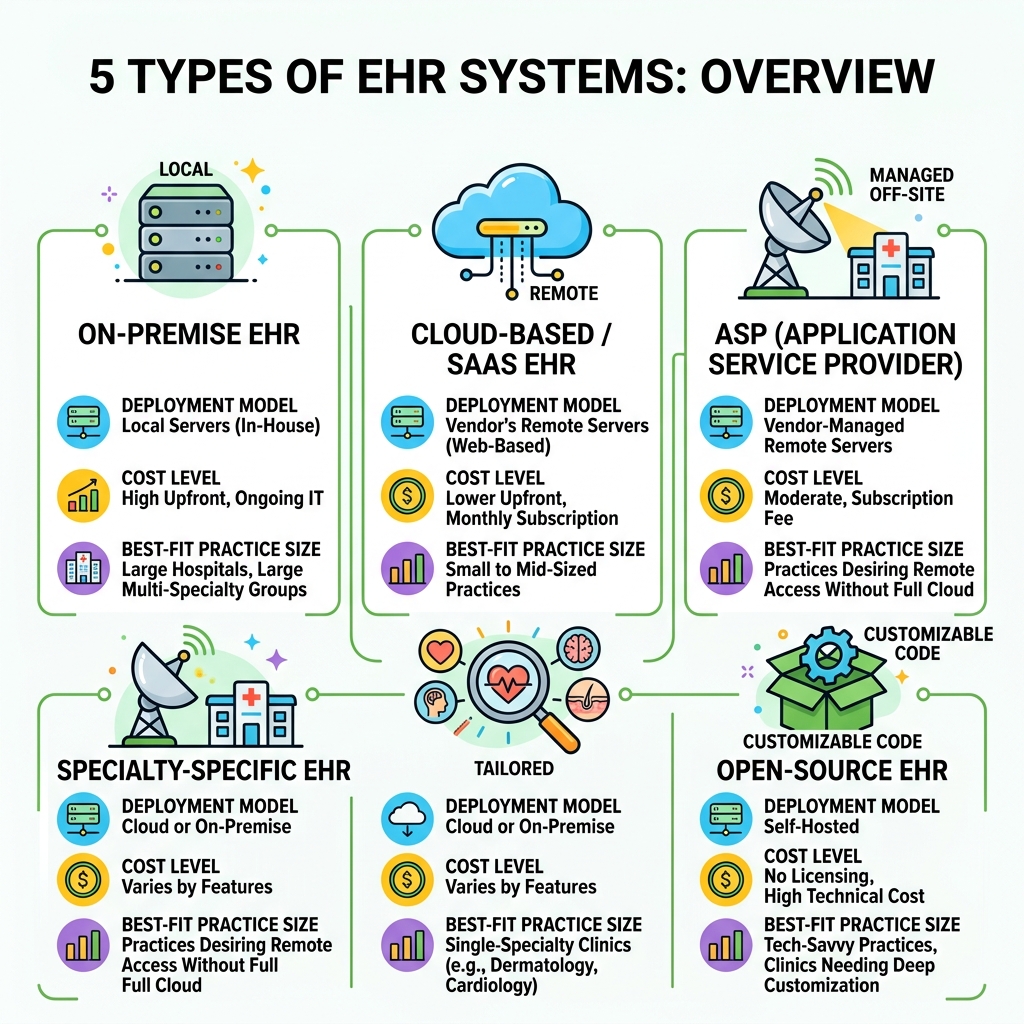
Here's a quick overview of the main types:
EHR Type Hosting Best For On-Premise Local servers (in-house) Large hospitals with dedicated IT teams Cloud-Based / SaaS Vendor's remote servers Small to mid-sized practices ASP (Application Service Provider) Vendor-managed off-site servers Practices wanting remote access without full cloud Specialty-Specific Cloud or on-premise Single-specialty clinics (dermatology, oncology, etc.) Open-Source Self-hosted Tech-savvy practices needing deep customization
Each model comes with real tradeoffs — in cost, security, interoperability, and administrative burden. And as someone who works with healthcare practices every day on billing and revenue cycle management, I've seen how the wrong EHR choice creates downstream problems: claim denials, compliance gaps, and lost revenue.
According to a 2024 CDC report, 95% of U.S. office-based physicians now use some form of EHR system. But adoption alone doesn't guarantee efficiency — or protection.
I'm Olivia Harper, Founder and Denial Management & Reimbursement Specialist at National Billing Institute, and with over 30 years of experience in medical revenue cycle management, I've worked alongside practices navigating the full spectrum of types of EHR systems and the billing complexities that follow each one. Understanding how these systems differ is the first step toward protecting your revenue and staying HIPAA-compliant.
Introduction
Electronic Health Records (EHR) are more than just digital versions of a paper chart. They are the central nervous system of a modern medical practice. At its core, an EHR system manages patient medical histories, medications, treatment plans, immunization dates, allergies, and test results. When implemented correctly, these systems drive digital transformation, enhancing patient safety through real-time clinical decision support and automated alerts.
However, the journey from the early Electronic Medical Record (EMR) to today’s interconnected EHR has been significant. While an EMR was traditionally a digital record used within a single office, a true EHR is designed to share information across different healthcare providers—such as laboratories, specialists, and pharmacies—to create a longitudinal view of patient health. This evolution is why the specific types of ehr systems you choose matter so much; they dictate how well you can communicate with the rest of the healthcare ecosystem.

Exploring the Primary Types of EHR Systems
When we talk about the different types of ehr systems, we are usually talking about how the software is deployed and where the data "lives." This hosting architecture affects everything from your morning login speed to how much you pay for IT support at the end of the month.
The decision often comes down to a choice between a physical data center located in your office versus a "cloud" icon on your desktop. This choice impacts accessibility (can you check a chart from home?) and scalability (can you easily add a new satellite office?). According to research on The 5 Different Types of EHR Systems & Which One To Choose | Pabau, matching the system to your practice size and technical capacity is the most critical step in the selection process.
On-Premise and Physician-Hosted Systems
On-premise systems, also known as physician-hosted systems, involve installing the software on servers physically located within your office.
The Pros: You have total control over your data. You aren't reliant on a third-party vendor's uptime, and you can customize the hardware to your heart's content.
The Cons: The upfront costs are substantial. We are talking about a hardware investment typically ranging from $25,000 to $100,000, depending on the size of your practice.
Maintenance: You are responsible for the "heavy lifting." This includes hardware maintenance, data backups, and cybersecurity. For most small practices in Boca Raton or across the US, the need for a dedicated, internal IT team makes this model prohibitively expensive.
Cloud-Based and SaaS Types of EHR Systems
Software as a Service (SaaS) and cloud-based systems are the current industry standard for a reason. In this model, the EHR vendor hosts the data on their remote servers, and you access it via a web browser or a secure app.
The primary benefit here is a lower total cost of ownership. Instead of a massive $50,000 check upfront, you typically pay a predictable monthly subscription fee. Updates happen automatically—usually several times a year—ensuring you always have the latest security patches and regulatory features without lifting a finger. As noted in Choosing the Right EHR: A Buyer’s Guide, cloud systems utilize "multitenancy," which allows the vendor to spread infrastructure costs across many practices, making high-end technology accessible to solo providers.
ASP and Open-Source Types of EHR Systems
If you are looking for a middle ground or total freedom, you might encounter these two types of ehr systems:
ASP (Application Service Provider): This is a precursor to the modern cloud. The vendor manages off-site servers, and you access the software remotely. While similar to SaaS, ASP models are often "closed" clouds, meaning they might lack the seamless network interoperability found in true cloud-based services.
Open-Source EHR: This gives you access to the software's source code. You can customize every single button and workflow. However, this comes with significant technical liability. You need an advanced IT team to maintain the system, as there is often no "1-800" number to call when things break. Research from Types of EHR Systems in Healthcare: Complete Guide 2025 - Pi Tech highlights that while open-source avoids licensing fees, the cost of custom development can quickly outpace a standard subscription.
Comparing Deployment Models and Practice Suitability
Choosing between these types of ehr systems requires an honest assessment of your practice's infrastructure. A large hospital system with 500 beds needs the robust, localized control of an on-premise system to handle massive data loads. Conversely, a small practice in South Florida likely needs the agility and remote access of the cloud.
The stakes are high. While 95% of physicians have adopted EHRs, the satisfaction levels vary wildly. Large networks, like the 150,000+ provider athenaOne network, thrive on cloud connectivity because it allows for shared clinical resources and easier data exchange with labs and payers.
Specialty-Specific vs. Multi-Specialty Systems
One of the most common mistakes we see at National Billing Institute is a specialty practice trying to use a "one-size-fits-all" EHR. A dermatologist doesn't document the same way an oncologist does.
Dermatology: Needs visual mapping and high-resolution photo storage for tracking lesions.
Oncology: Requires complex protocol tracking and integration with clinical trials.
Chiropractic: Benefits from spine mapping and posture assessment tools.
Behavioral Health: Needs specific privacy controls and therapy-note templates.
Using a specialty-specific system reduces documentation errors because the templates are built for your specific workflow. According to Different Types of EMR Systems: A Complete Guide (2026), these tailored systems can significantly reduce "click fatigue" and improve the accuracy of the data we eventually use for billing.
Security, Compliance, and Interoperability Standards
Security is not optional. Every EHR type must comply with the Health Insurance Portability and Accountability Act (HIPAA) and the HITECH Act. This means your system must include:
Data Encryption: Protecting data both at rest and in transit.
Multi-Factor Authentication (MFA): Ensuring only authorized staff can log in.
Audit Trails: Recording exactly who accessed which record and when.
The biggest hurdle in the industry remains "interoperability"—the ability of different types of ehr systems to talk to each other. We are moving toward standards like FHIR (Fast Healthcare Interoperability Resources) and HL7 protocols to break down "data silos." Without interoperability, your patient’s ER visit data might never reach your primary care office, leading to dangerous medication interactions. As highlighted by Physicians choose their top 10 EHR systems for 2026 - Praxis EMR, interoperability is a top priority for physicians looking to improve care coordination.
Selection Factors and Future Trends in EHR Technology
The future of EHR is AI-powered. We are seeing a massive shift toward automation that actually helps the doctor instead of hindering them.
Ambient Listening: AI "listens" to the patient encounter and drafts the clinical note for the doctor to review, potentially reducing charting time by 40-50%.
Predictive Analytics: Systems can now flag patients at high risk for readmission or specific chronic conditions.
Voice Recognition: Modern systems allow for hands-free documentation, which is a game-changer for busy clinicians.
When evaluating a vendor, don't just look at the features—look at the support. Will they be there at 2:00 PM on a Tuesday when your billing interface fails? At National Billing Institute, we specialize in integrating medical billing with various EHR types to ensure that these technological advancements actually translate into faster reimbursements and fewer denials.
Selection Pitfalls and Professional Liability Risks
Choosing the wrong EHR isn't just an administrative headache; it’s a liability risk.
Alert Fatigue: If an EHR sends too many irrelevant "pop-up" warnings, clinicians start ignoring them. If a critical drug-allergy alert is ignored, the physician may be held liable under "learned intermediary theory."
Vendor Insolvency: If your cloud vendor goes out of business, what happens to your data? Always look for "data portability" clauses in your contract.
Data Ownership Disputes: Some vendors have been known to "hold data hostage" during fee disputes. Ensure your contract explicitly states that the patient records belong to the practice.
Click-Through Contracts: Many SaaS providers use "take it or leave it" digital contracts that may include unfavorable indemnification clauses.
According to the EHR Software Comparison | 2026 Pricing, Features & More, understanding these risks during the selection phase is vital for long-term practice stability.
Frequently Asked Questions about EHR Systems
What is the difference between EMR and EHR?
While often used interchangeably, an EMR (Electronic Medical Record) is a digital version of a patient's chart within one practice. An EHR (Electronic Health Record) is a more comprehensive, shareable record designed to follow the patient across different healthcare organizations and specialists.
Which EHR system type is best for a small practice?
For most small practices, a Cloud-Based SaaS EHR is the best fit. It eliminates the need for expensive in-house servers and IT staff, offers predictable monthly costs, and allows for remote access, which is essential for modern telemedicine and after-hours care.
How does AI enhance traditional EHR types?
AI enhances EHRs by automating repetitive tasks. This includes ambient scribing (creating notes from conversations), predictive analytics for patient health risks, and AI-automated claims processing, which catches coding errors before they lead to a denial.
Conclusion
Selecting from the various types of ehr systems is a strategic decision that will define your practice’s operational efficiency and financial health for years to come. Whether you opt for the total control of an on-premise system or the streamlined flexibility of the cloud, your choice must align with your clinical workflows and your long-term growth goals.
At National Billing Institute, we understand that technology is only as good as the revenue it generates. Our 100% USA-based team in Boca Raton, FL, brings over 30 years of experience to the table, helping you navigate the complexities of EHR integration and medical billing. We pride ourselves on maintaining the industry's lowest denial rates and helping our clients see a 15-30% increase in revenue through expert cycle management.
Don't let your EHR become a barrier to your practice's success. Contact us to discuss our full-service medical billing and RCM services and let us help you turn your digital records into a engine for revenue integrity.
